
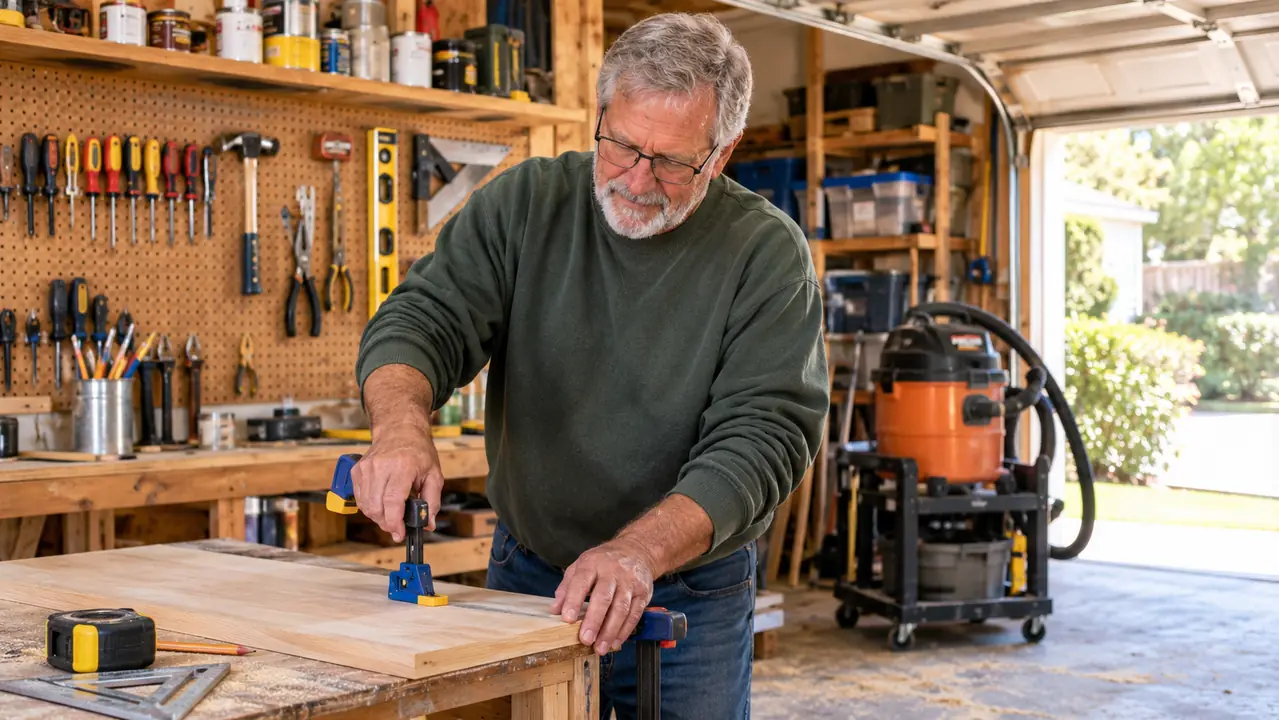
Pocket-hole joinery gets dismissed as the beginner's joint. I have heard that for twenty-five years of weekend work, and I still reach for it first on half of what comes across my bench. The jig I keep going back to is the Kreg R3, and it earns its pegboard hook for reasons that have nothing to do with how fast it looks in a video.
My shop is one bay of a converted two-car garage outside Richmond. I build shelving, small boxes, cutting boards, Adirondack chairs, a picnic table every few summers, and the occasional simple cabinet for the family. No clients, no cabinet business, just the list on the wall. Every one of those projects asks the same thing: a joint that holds, done before the weekend runs out. The R3 answers that. Here are ten reasons it stays within arm's reach.
Ten reasons, one 16-ounce jig
The Kreg R3 puts the drill guide, a 6-inch driver bit, a depth collar, a clamp adaptor and an Allen wrench into one compact case. If your projects look like mine, that is most of what you need on the bench.
Amazon Check Today's Price on Amazon →It weighs 16 ounces, so it goes where the work is
Sixteen ounces. That is a paperback and a half. I have carried it out to the driveway to drill picnic table parts laid across sawhorses, and I have carried it to the truck bed when a lumber run turned into an assembly job in the yard. Nothing about it needs a bench, and nothing about it needs to be bolted down. The compact carrying case keeps the bit and the collar in one place, so it comes off the wall as a unit and goes back the same way at the end of the afternoon.
Nine depth settings cover the stock in my rack
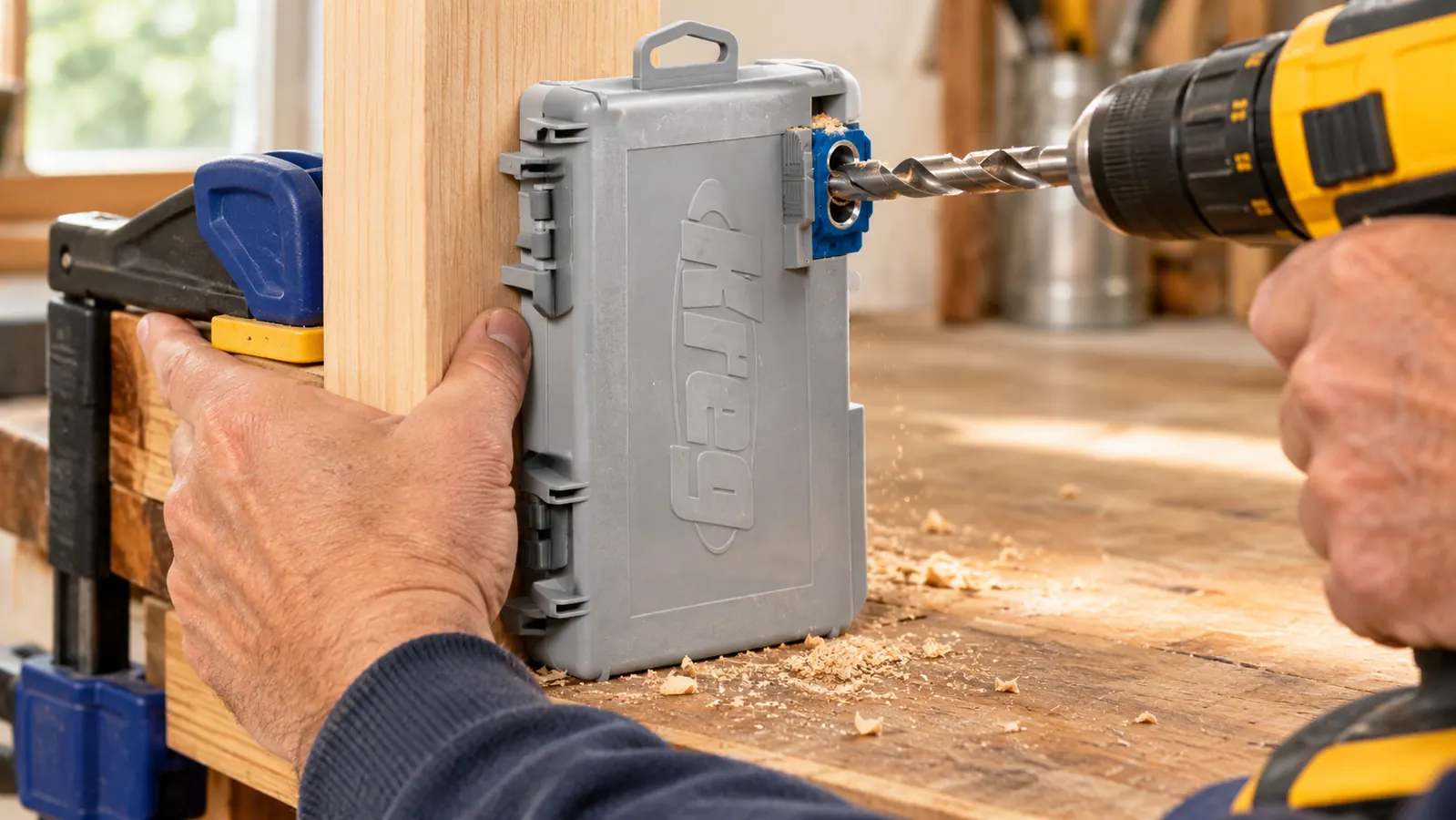
The positioning sliders have nine depth settings, and that range covers the material I actually buy. Half-inch ply for box bottoms. Three-quarter stock for shelving, face frames, and the rails on a small cabinet. Thicker stuff for outdoor parts. Setting the guide to the stock is a slide and a lock, not a measurement. After the first hole of a session I stop checking, and that is the point. A jig that makes you re-measure every joint is a jig you quit using by the second weekend.
The clamp adaptor works with the clamps already on my wall
The kit includes a clamp adaptor and a clamp pad, and together they let the drill guide sit against most clamps. I already own bar clamps and a couple of quick-grip styles, so nothing extra had to come home with the jig. Clamp the workpiece to the bench, seat the guide, drill. That is the operation. It repeats without the piece creeping between holes, which matters when you are drilling a matched pair of side panels and want them to line up at assembly.
The 6-inch driver bit keeps the chuck off your finished face
A short driver bit plus a drill chuck that wants to spin against the workpiece is how you scar a face you just finished sanding. The included 6-inch driver bit puts the chuck well clear of the wood, so the spinning mass stays away from the surface. It runs in a half-inch chuck without complaint. I have driven hundreds of screws with mine and the tip still seats without wobble, which is more than I can say for the bargain bits in the bottom of the drawer.
The depth collar sets screw depth once and repeats it
Blow-through is the failure that ruins a shelf. The depth collar clamps onto the bit and stops the screw at the same depth every time. That matters most on a long run of holes, when your attention has moved on to the next item on the list and your hands are working without you. Set the collar on a scrap of the same thickness, tighten it, and stop thinking about it. One test piece at the start of a session saves a panel later in the afternoon.
It runs on the drill you already own
The R3 is a guide, not a machine. It is compatible with drills and clamps, and the clamp adaptor is what makes the second half of that sentence useful. There is no second tool to buy and no station to bolt to the bench. I keep two cordless drills within arm's reach, one set up for drilling and one for driving, and the jig moves between them as the work moves. On a shelving project, that back and forth is the whole rhythm of the day.
It handles 1 1/2 inch stock, which is most of what I build with
The drilling capacity is 1 1/2 inches. That is two-by material, which covers picnic table aprons, chair legs, and the frames on a set of shop shelves. It is also the honest ceiling. I would not ask it to bore into a four-by-four post, and in twenty-five years of weekend work I have never needed to. Knowing where a tool stops is half of trusting it, and this one stops at a thickness I can plan around before I leave for the lumber yard.
It stores in a drawer instead of on the bench
The jig measures 8 by 2.25 by 5 inches, and the compact carrying case is not much bigger. In a one-bay garage shop, horizontal surfaces fill up with clamps, offcuts, and coffee cups, so a tool that lives in a drawer instead of claiming bench space is a tool that gets picked up. The body is plastic, which I mention because a Virginia garage swings from humid in July to cold in January, and plastic does not rust or swell the way a steel block would.
The guide reaches angles a fixed block cannot
The drill guide is built to make joints at several angles, so inside corners and faces that would be awkward with a fixed block are not a problem. I use that most on small boxes, where the pockets go on the inside and the outside face stays clean for finish. An Allen wrench ships in the case with it, which is the kind of small item you do not want to be hunting for during a glue-up. It stays with the kit and it stays findable.
It makes a joint I trust on outdoor furniture
Adirondack chairs and a picnic table live outside year-round at my place, and they take weather, weight, and being dragged across a patio. Glue plus screws in a pocket hole gives a joint that pulls tight and stays tight. When a chair arm works loose after five summers, I can back the screw out, clean the joint, and re-drive it without cutting anything new. That repairability is worth more to me than a fancier joint that fails once and fails permanently.
What I'd Skip
Two things, stated plainly. A pocket hole is not a hidden joint. On a face that shows, you are plugging the hole, trimming the plug flush, and sanding, and that is real time on a project where the joint was supposed to save you time. If the piece is going in the living room, plan for the plugs. Second, the R3 does not include a clamp. You supply that, so check that what you own suits the adaptor before you start, or add one to the list. And if you build cabinet boxes by the dozen, step up to a benchtop jig with a fixed clamp, like the Kreg K4. For the projects I build, that step up takes more bench space than the work asks for.
Set the collar on a scrap once, and forty screws later you are still not thinking about it.
If your project list is longer than your weekends
The R3 is the jig I reach for on shelving, small boxes, and anything headed outdoors. Nine depth settings, a depth collar, a 6-inch driver bit, and a case that fits in a drawer.
Amazon Check Today's Price on Amazon →