

Eight months ago I finally retired a quarter sheet sander that had been leaving pigtails in every cutting board I glued up, and replaced it with the Bosch ROS20VSC. I had put that decision off for two years. The first afternoon I ran it along a maple edge grain board, the difference showed up in about half a minute. No swirl marks. No chatter when I crossed the end grain. The dust went into the canister instead of onto the pegboard behind me. I am not easy to impress with a sander, and I stood there grinning like a fool.
That is the short version. The longer version is that this is a 5 inch random orbit sander with a 2.5 amp motor, a 3.5 pound body, and a dust canister that traps particles down to a half micron. It is corded, which suits a shop with a 20 amp circuit I ran myself. In my garage it has one job: flatten, smooth and finish the panels, boards and chair parts I haul home in the truck. Eight months of weekends later, here is what I actually think of it.
The Quick Verdict
A well behaved 5 inch orbital that keeps swirl marks out of a finish and keeps dust out of the air. Heavier than a palm sander and no hog, but for furniture work it has been the right tool eight weekends out of ten.
Amazon Check Today's Price →The Sander That Ended My Swirl Mark Problem
If pigtails are showing up in every glue up you finish, this is the tool that stopped mine. Corded power, 5 inch discs, dust that lands in the canister instead of your lungs.
Amazon Check Today's Price on Amazon →How I've Used It
My shop is one bay of a two car garage outside Richmond, Virginia. Concrete floor, a 20 amp circuit I ran myself back when I still had the patience for conduit, a shop vac on a cart, and a pegboard wall that has seen better days. Most of what I build is family furniture: cutting boards, small boxes, bookshelves, a cedar chest for my daughter, Adirondack chairs, and a picnic table that lives outdoors year round. Carol has been asking for a new set of shelves since spring, which is the only reason I know exactly how many weekends I have put on this sander.
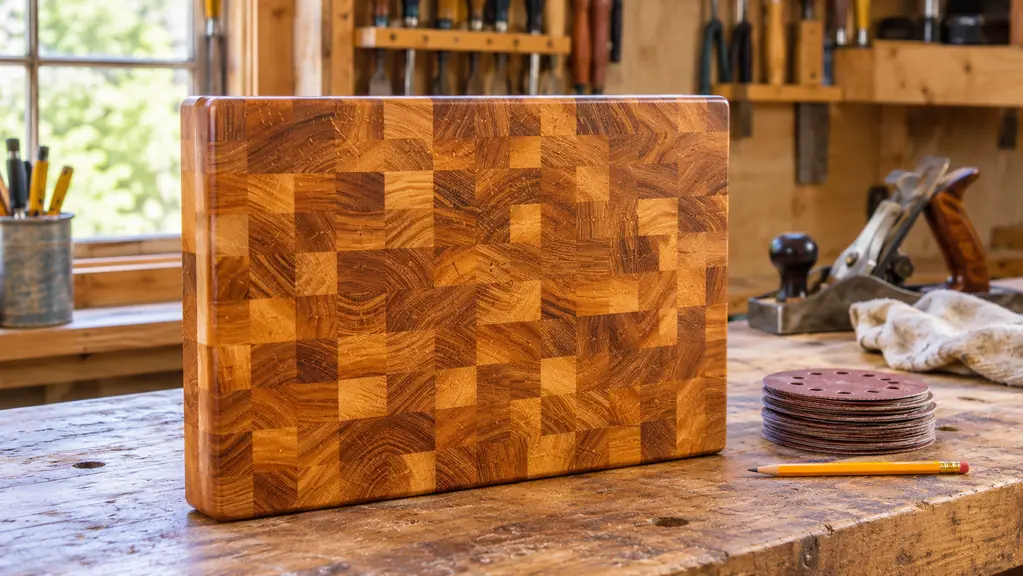
The cutting boards are where it earns its keep. I glue up maple and walnut, let the panel cure overnight, then flatten it. A board that comes out of the clamps slightly out of flat used to cost me twenty minutes of hand sanding and still show scratches under a raking light. With this tool I work 80 grit until the surface is even, then 120, 180 and 220. The last pass under a shop light shows a uniform surface with no cross grain scratches and no little circles. That is the whole review right there, but the rest of it matters too.
The rest is chair work, which is harder on a sander than any flat panel. Cedar for the Adirondacks, pine for shelving, and a set of small boxes in cherry that I gave away at Christmas. On the curved arms and the shaped backs I run the tool with two hands and let it float rather than press. It has not dug a divot in anything yet, and the backing pad is still the one that came in the box. That is after eight months of weekends, which for a hobby shop is maybe sixty or seventy hours of actual running time.
What the Pad Dampening Actually Does
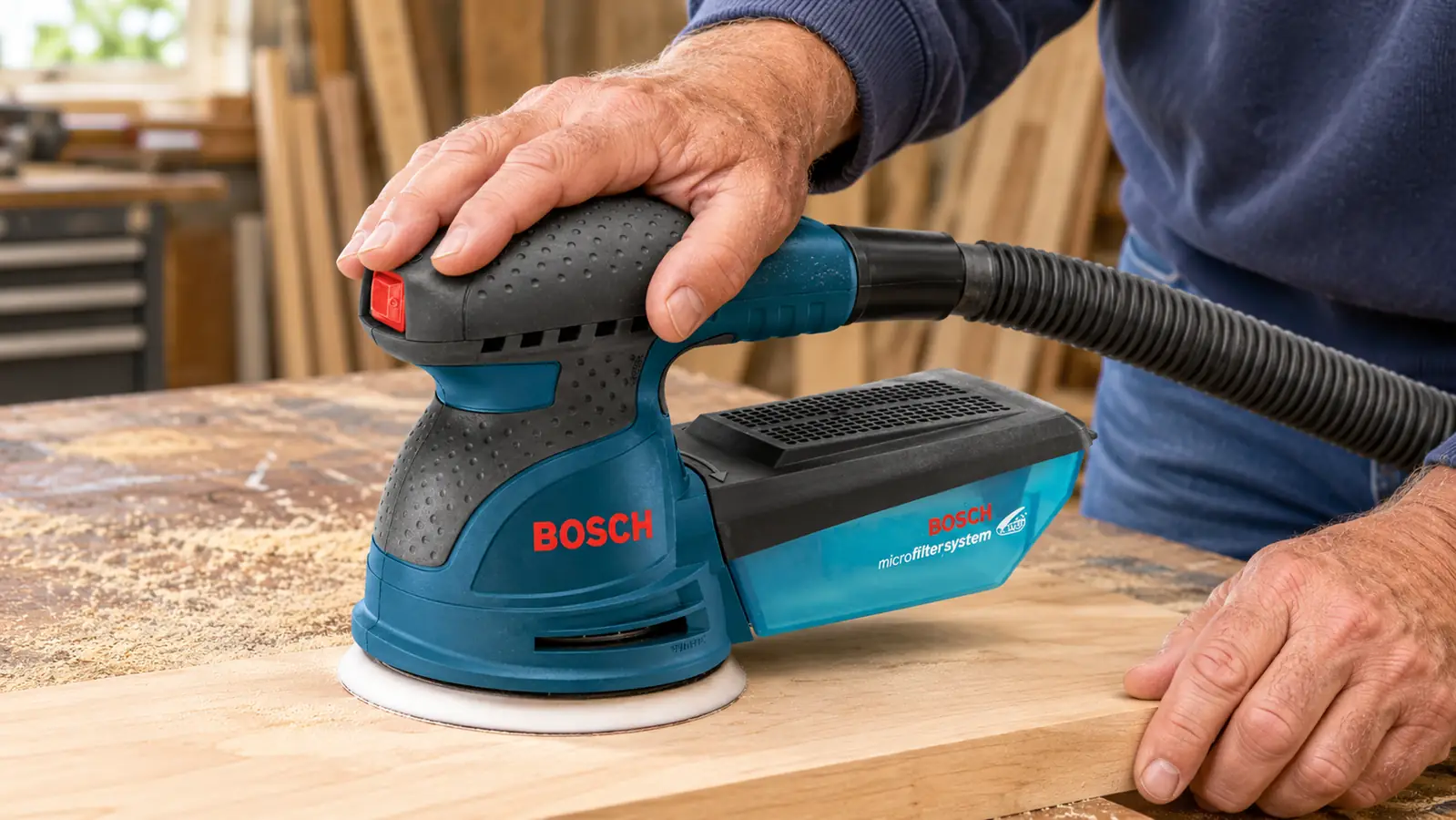
Swirl marks come from a disc that is not moving the way it should. On a cheap orbital the pad tips slightly under hand pressure, one edge digs in, and you get those comma shaped scratches that only show up after the first coat of finish. The Bosch uses a pad dampening system, which is a soft ring between the pad and the body that lets the pad conform to the surface instead of fighting it. The listing says it is designed to eliminate swirl marks on both flat and contoured surfaces. That matches what I see.
The included soft backing pad does the other half of the work. It gives a little under the disc so the paper follows a slight curve instead of bridging it and burning the high spot. On the shaped arms of an Adirondack chair that is the difference between a fair curve and a flat spot with a ring around it. I have not had to touch up a single curved part by hand since I started using this sander, and before that I did it on every chair.
It is not magic, and I want to be clear about that. If you tip the tool up on one edge and lean on it, you will still make marks, because the pad can only damp so much. What it does is forgive the ordinary variation in hand pressure that any human being brings to a board. My old quarter sheet sander punished every wobble. This one absorbs it. That is a meaningful difference for someone who sands on a Saturday morning and not eight hours a day.
Dust Is Half the Job
The dust canister and micro filter system are the part I underestimated. The listing claims the filter traps particles as small as a half micron, and I cannot verify that with a meter, but I can tell you what my garage looks like. Before, a sanding session meant a visible haze and a fine layer of maple flour on every horizontal surface, including the shelf where Carol keeps the garden gloves. After, the canister fills up and the air stays clear enough that I stop noticing it.
The vacuum hose adapter is the upgrade I would make on day one if I were starting over. The canister works fine for a few minutes of work, but it fills fast on a big panel, and once it is half full the collection drops off. I run the adapter to the shop vac on the cart for anything larger than a small box, and the difference is not subtle. Almost nothing escapes. The bench stays clean, which means I spend my time sanding instead of wiping down.
This matters more in a garage shop than it does in a standalone building. My shop shares a wall with the house. Fine dust finds its way through a door frame whether you believe it will or not. Capturing it at the source, with a half micron filter and a vac attached, is worth more to me than any other feature on the tool. If you take one thing from this review for a garage setup, take that.
Five Inches, Three and a Half Pounds
Five inch discs are the right size for furniture work, and I will argue that with anyone. A 5 inch pad covers a cutting board in a few passes but still fits between the arms on a chair back. The tool itself measures 9 inches long, 5 inches wide and 6 inches high, and it weighs 3.5 pounds. That is heavier than a palm sander and lighter than anything with a real motor behind it. In the hand it feels substantial without being clumsy.
On flat work I run it one handed and guide it with the other, and it tracks where I point it. On vertical surfaces, like the face frame of a cabinet, the weight starts to matter after ten minutes. On overhead work, which for me means the underside of a table or the stretcher on a bench, 3.5 pounds gets heavy fast. I do those in short passes and set the tool down between them. That is not a complaint about the sander, it is just the honest arithmetic of holding three and a half pounds above your shoulder.
The cord is the other thing to think about. It is a corded tool, 120 volts, and it does not slow down under load the way a battery tool will when the pack gets low. That consistency is why I wanted it. It also means you are managing a cord across the bench, and I have caught it on the corner of a board more than once. A simple hook on the pegboard solved that for me. Small annoyance, real benefit.
Speed, Control, and Where It Fights Back
The motor runs between 7,500 and 12,000 orbits per minute with no load, and the listing describes the point as matching speed to the work piece and the task. In practice I run it slower when I am on a finish pass and faster when I am knocking down mill marks on a fresh board. Being able to back the speed off is what lets me take a 220 grit disc to a board without burning the surface. That control is worth more than raw power in a furniture shop.
Where it fights back is stock removal. This is not a tool that will flatten a cupped board or take a sixteenth off a glued up panel. It will not do it, and if you try you will spend a long time and a lot of paper learning that. Rough flattening in my shop is a hand plane or a trip to the lumber yard for a straighter board. The Bosch starts its life at the point where the panel is already flat and needs to be made smooth. Expect that and you will be happy with it.
Paper choice matters more than I expected. Cheap discs load up in about ninety seconds on walnut and then the pad starts to skid. Good stearated paper in 80, 120, 180 and 220 covers everything I build, and the discs are common enough that I can pick them up locally instead of waiting on a shipment. I change discs more often than I used to. A fresh disc running at the right speed does more work than a worn one pressed hard, and it leaves a better surface.
What I Liked
- Pad dampening keeps swirl marks out of a finish, on flat panels and curved parts
- Dust capture is genuinely effective, especially with the vacuum adapter and a shop vac
- Corded 2.5 amp motor holds speed under load without fading
- Speed range from 7,500 to 12,000 orbits per minute lets me match the pass to the task
- 5 inch discs are available anywhere and cover furniture sized parts quickly
- 3.5 pound body feels solid and tracks straight on flat work
Where It Falls Short
- It is a smoothing tool, not a flattening tool, and it will not remove serious material
- The dust canister fills quickly on large panels, so a vac is close to mandatory
- 3.5 pounds gets tiring on overhead and long vertical passes
- The cord needs managing across a bench and catches on board corners
- It ships with a contractor bag rather than a hard case
Eight months in, the only part that has worn is the paper. The backing pad that came in the box is still on the tool, and I have not seen a single swirl mark in a finish since the first week.
Who This Is For
This is for the hobby woodworker with a garage shop and a project list that runs to cutting boards, shelving, small boxes and outdoor furniture. Somebody who has already figured out that hand sanding a glued up panel is a young man's game and would like to keep the feeling in their hands for the next twenty years. If you are building a few pieces a season and you want a finish that holds up under a raking light, this tool does that job without drama.
It also suits anyone who shares a wall with the house. Between the canister, the micro filter rated to a half micron, and the vacuum adapter, this is one of the few sanders I have used where I do not walk into the kitchen afterward and get told I have been sanding. Carol notices these things. That alone has been worth the switch, and I say that as someone who resisted it for two years.
Who Should Skip It
If your work starts with rough lumber and you need to take real material off before anything else happens, skip it and buy a belt sander or learn the hand plane. This is a finishing tool. It will not true up a twisted board and it will not hog down a butcher block end grain glue up in any reasonable amount of time. Buying it for stock removal and then being disappointed is the most common way I see people sour on a very good sander.
If you work in a driveway or on jobsites and need to move constantly, a corded tool with a hose hanging off it will annoy you. And if you sand for a living, eight hours a day, five days a week, you may want to look at a larger orbital with a bigger pad and a proper extraction setup, because 3.5 pounds in one hand adds up over a career. For a weekend shop like mine, it is the right size and the right weight.
If Your Finish Still Shows Swirls, Start Here
Corded, 5 inch, 2.5 amp, and eight months of weekends without a hiccup. More than five thousand ratings on Amazon, and mine would be another good one.
Amazon Check Today's Price on Amazon →