
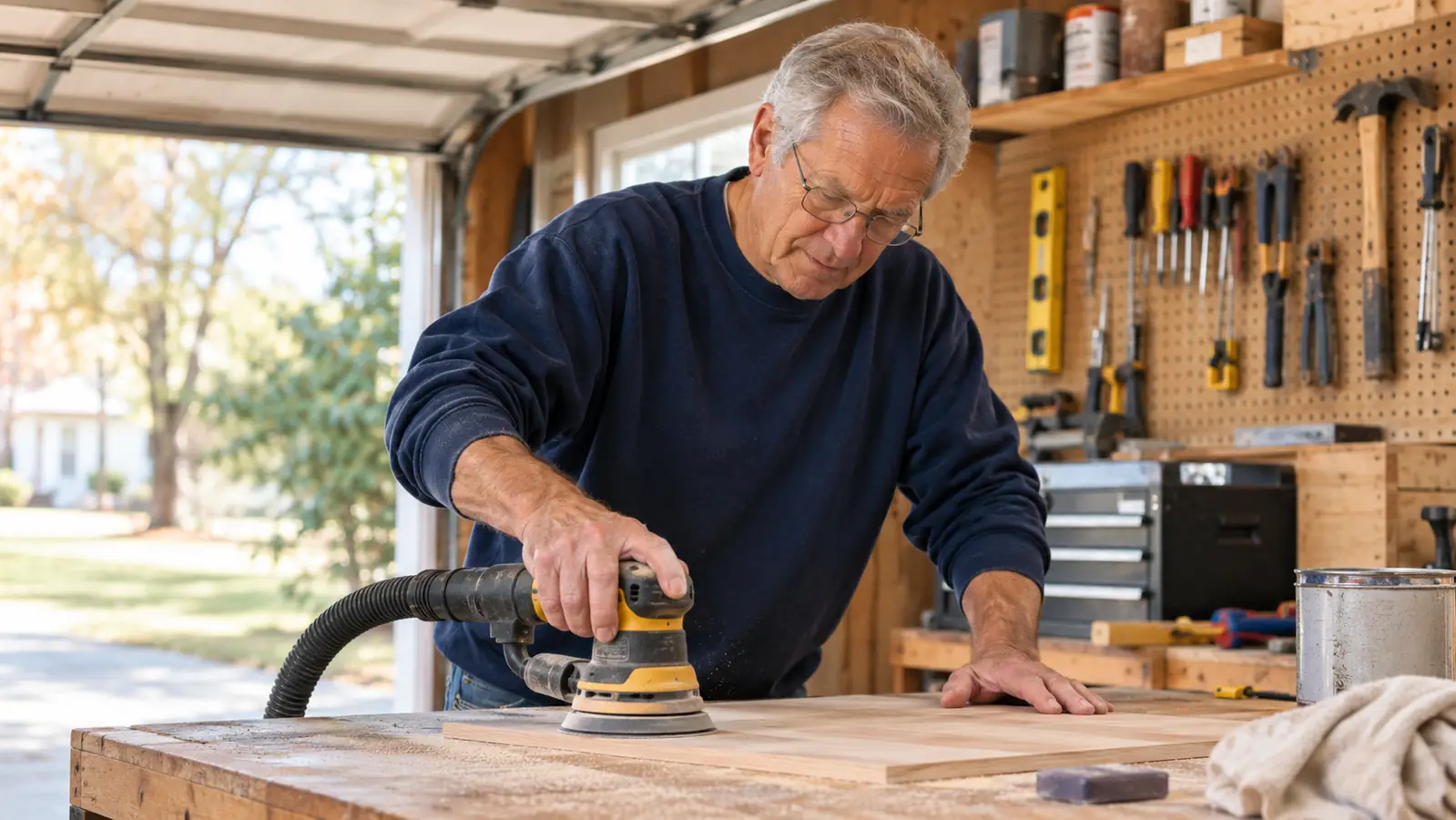
I spent my first ten years of weekend woodworking sanding by hand. A cork block, a folded sheet of 80 grit, and an afternoon gone. It works. It also leaves your fingertips numb and your tabletop slightly dished where your palm pressed harder than your fingers did. The afternoon I brought home a Bosch random orbit sander, the same glued-up tabletop went from rough to ready in about forty minutes, and it came out flatter than anything I had ever managed with a block. That was the end of hand sanding for anything bigger than a cutting board.
What follows are the ten reasons that happened, in the order I noticed them. Some of them are about speed. More of them are about the finish, because that is where hand sanding actually loses. I work out of a converted two-car garage outside Richmond, one bay for the shop and one for the truck, and everything here is written with that kind of work in mind: shelving, picnic tables, cedar chests, small boxes. Nothing on this list needs a professional cabinet shop to make sense.
The tool that retired my sanding block
The Bosch ROS20VSC is a 5 inch corded random orbit sander with a 2.5 amp motor, a pad dampening system built for swirl-free work, and a micro filter dust canister. It is the one I reach for before I reach for sandpaper.
Amazon Check Today's Price on Amazon →It leaves no swirl marks on a flat glue-up
This is the one that surprised me. A sander that spins in a plain circle drags grit in the same arc every pass, and you get pigtails that only show up after the stain goes on. The Bosch runs an orbital motion with a pad dampening system built to cancel that out, so the scratches cross each other at changing angles and the surface reads uniform. I have sanded three cedar chests with it and never once had to chase a swirl back out with a block.
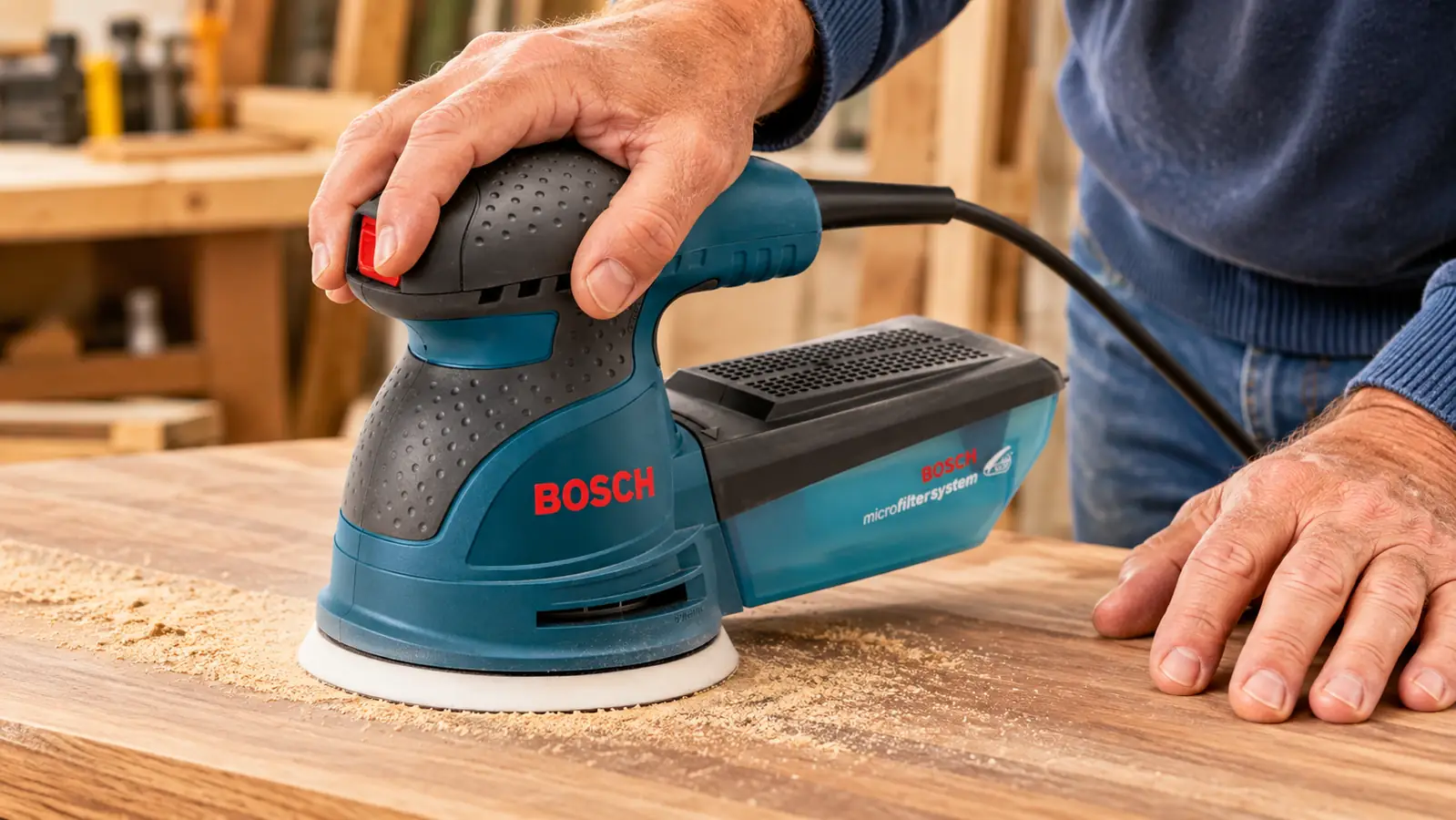
A 5 inch disc covers ground a sanding block cannot
My block was about two and a half inches across, and I leaned on it. The Bosch carries a 5 inch disc, so each pass covers roughly four times the area and the pad stays flat across the whole face. A glue-up for a bookshelf side went from a twenty minute job to something I finished before my coffee went cold. On wide panels the difference compounds, because you are not overlapping your own passes nearly as much.
Your fingertips stop steering the cut
Hand sanding is a pressure problem. Your fingers find the high spots and dig in, your palm rides the low ones, and after an hour you have a surface that looks fine under the shop light and shows every dip under a raking finish. A random orbit sander spreads the load across the whole pad. You guide the machine, you do not carve with it. That single change is why my tabletops finally came out flat instead of almost flat.
The 2.5 amp motor holds speed when you lean on it
Cheap sanders bog the moment you put weight behind them. The pad slows, the scratch pattern goes erratic, and you press harder to compensate, which makes it worse. The Bosch has a 2.5 amp motor and it keeps its speed under a normal working load. You can feel the difference on hardwood. It cuts at the same rate on the first pass and the tenth, so you are not guessing whether a spot got enough attention.
7,500 to 12,000 orbits per minute covers both ends of the job
The motor runs between 7,500 and 12,000 orbits per minute, which is enough range to take 80 grit down through a rough panel and still be gentle enough for a 220 grit pass before finish. That matters more than it sounds. A single speed sander forces you to pick your grit around the machine's one setting. Matching the speed to the work means fewer passes at each grit and less chance of burning an edge.
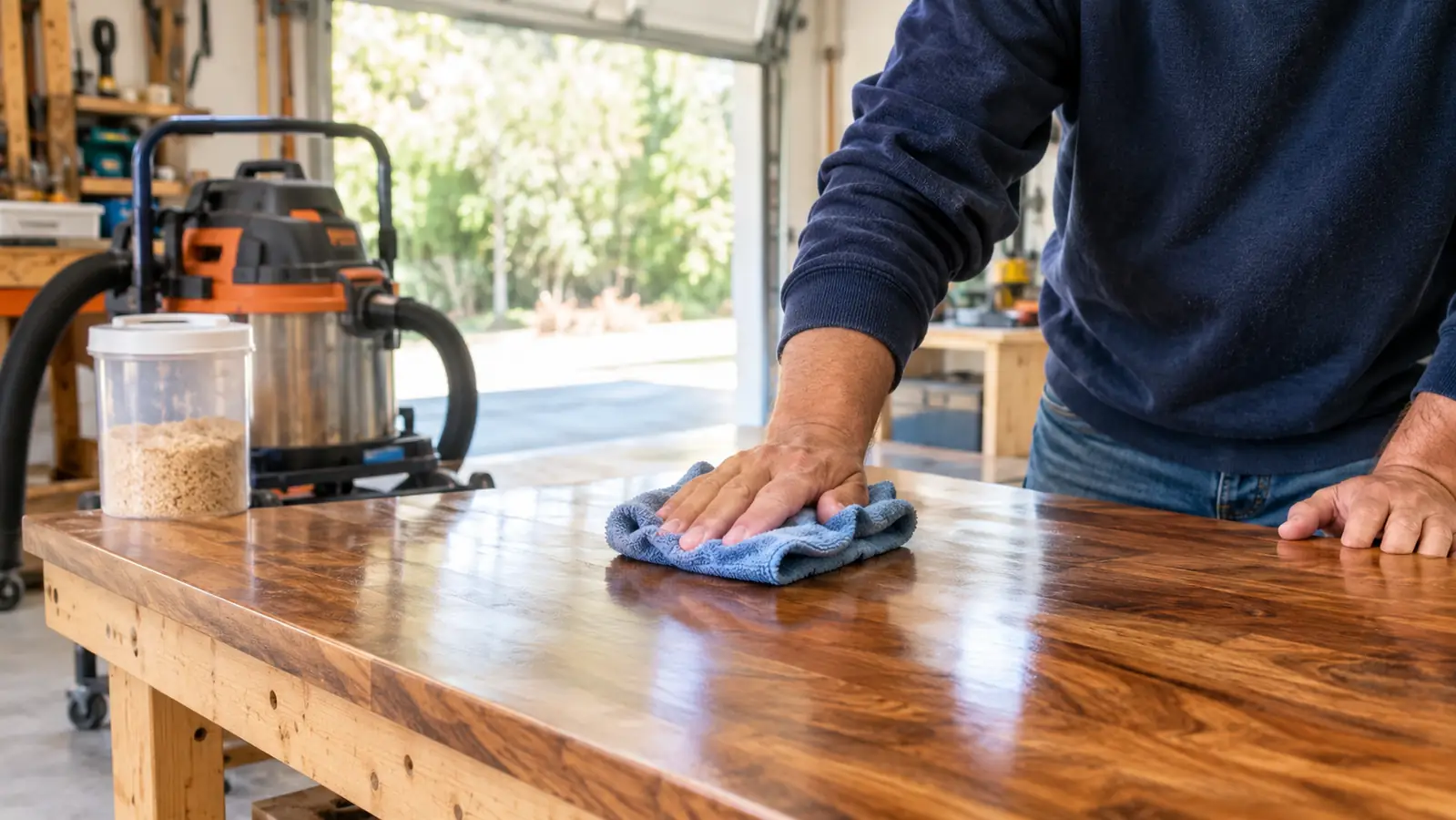
Dust lands in the canister instead of on your pegboard
The micro filter system traps particles down to a half micron, and the canister fills up faster than you expect, which is a good sign. There is also a vacuum hose adapter in the box if you want to run it to a shop vac, and I do, because my shop shares a wall with the laundry and Carol has opinions about dust. Fine dust is the part of sanding that hangs in the air for hours. Catching it at the pad solves a problem I used to solve with a respirator and a broom.
Corded power means it runs as long as you do
It is a 120 volt corded tool pulling 2.5 amps, which on the 20 amp circuit I ran to the shop is nothing. No battery to swap, no charge cycle to wait out, no drop in speed as a pack drains. When I am sanding a set of Adirondack chairs I want to keep moving until the job is done. The cord is the trade, and a cord is easier to manage than a second battery sitting on a charger in the other bay.
3.5 pounds does not wreck your shoulder by the third hour
The sander weighs 3.5 pounds and measures about 9 by 5 by 6 inches, small enough to hold over an edge and light enough that a long session does not leave my arm shaking. Hand sanding is worse than people admit. The tool is light, the effort is not. Being able to set the machine down on the work and let it do the cutting is the reason I can still sand on a Saturday morning at 63.
Sandpaper lasts longer when the pressure is even
Easy to miss. Hand sanding loads a sheet in the middle, where your fingers press, and the corners stay sharp and unused. A random orbit pad wears a disc evenly across its face, so you get the full life out of it instead of tossing half a sheet. I go through noticeably fewer discs per project than I did sheets, and I am not digging through a drawer looking for a piece of 120 that still has grit on it.
The finish takes stain evenly the first time
Everything above adds up to this. Uniform scratches mean uniform absorption, which means stain goes on without blotching and the second coat does not have to fix the first. I have had projects where I sanded by hand for an hour, stained, and spent the next evening sanding back a patchy area. I have not had one of those since the Bosch came into the shop. That is the real argument. The time saved is nice. The redo you never have to do is better.
A tabletop that used to eat an afternoon now takes forty minutes, and the scratch pattern is even enough that stain takes right the first time.
What I'd Skip
I would skip anything coarser than 80 grit on a finish surface unless you are hogging material off a deck board. I would skip the quarter sheet palm sander entirely if you already own a random orbit, because it does the same work slower and with more swirl risk. And I would skip talking yourself into hand sanding a large panel to save setup time. Unrolling a cord and clamping the work takes two minutes. An afternoon with a block takes an afternoon. My long-term notes on this machine live in my Bosch ROS20VSC review, and the comparison against a palm sander is worth a read if you are still deciding between the two.
If you sand anything bigger than a cutting board, get the sander
Corded, 5 inch, 2.5 amp, with a dust canister that actually catches the fine stuff. The difference is between sanding being the job and sanding being the step before the job.
Amazon Check Today's Price on Amazon →