
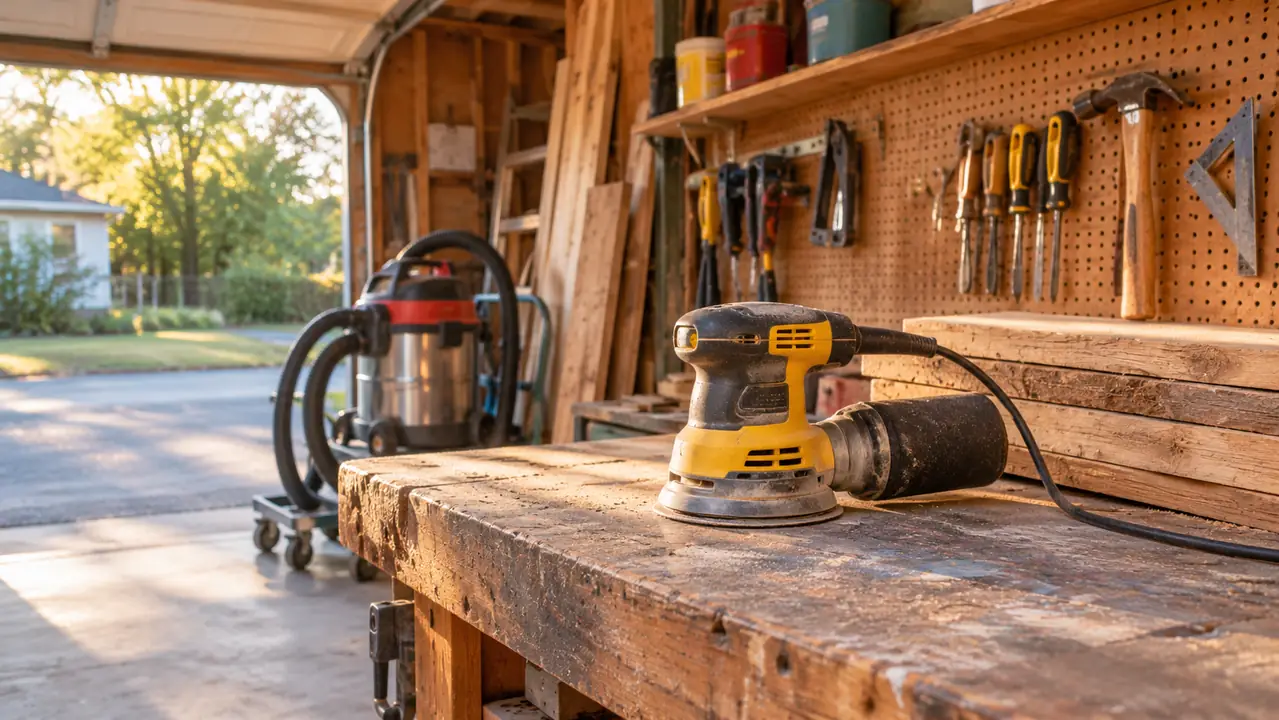
The palm sander was the second power tool I ever bought. Quarter sheet pad, rectangular, paper clamped at both ends, and enough vibration in the handle to numb your fingers after twenty minutes. It built bookshelves, a cedar chest, and the first set of Adirondack chairs that ever came out of this garage. Then I bought the Bosch ROS20VSC, and for most of one season the palm sander sat on the shelf under the pegboard while the random orbit did the work. That is not the same as saying the palm sander is finished, because it is not. The two tools solve different problems, and once you know which problem is yours, the choice stops being a debate.
Here is the short answer. For flat panels, glued up boards, tabletops, and anything that has to come out clean under a raking light, the Bosch ROS20VSC wins, and it is not close. A random orbit sander spins the disc and orbits it at the same time, and that second motion is what keeps the abrasive from cutting the same groove over and over. For inside corners, narrow stiles, and pockets where a five inch disc will not fit, a quarter sheet palm sander is the right tool and always will be. Most garage shops end up with both. If you can only own one, buy the Bosch first and pick up a palm sander for the corners later.
| Bosch ROS20VSC | Quarter sheet palm sander | |
|---|---|---|
| Upfront cost | Costs more up front, and the 5 in. discs cost more than sheet paper | Costs less up front and runs on cheap quarter sheets cut from a full sheet |
| Flat panel finish | Random orbit action plus a pad dampening system, so swirl marks stay away | Orbital action tracks the same loop and can leave pigtails with coarse grit |
| Inside corners | A 5 in. round disc does not reach a 90 degree inside corner at all | Rectangular pad gets into corners and along narrow stiles |
| Dust capture | Micro filter canister rated to a half micron, plus a vacuum hose adapter in the box | Usually a small bag or a short port, and a lot of it lands on the floor |
| Contoured work | Pad dampening is designed for flat and contoured surfaces | A flat pad bridges the curve and digs at the high spots |
| Abrasive cost over time | 5 in. hook and loop discs, bought in packs, and you go through a lot of them | Quarter sheets torn from a full sheet, the cheapest abrasive there is |
| Changing grits | Peel a disc off, press a disc on | Loosen two clamps, line up a sheet square, tighten both clamps |
| Best for | Panels, tops, doors, shelves, anything wide and flat | Corners, face frames, repairs, small parts |
What the Bosch Actually Does Differently
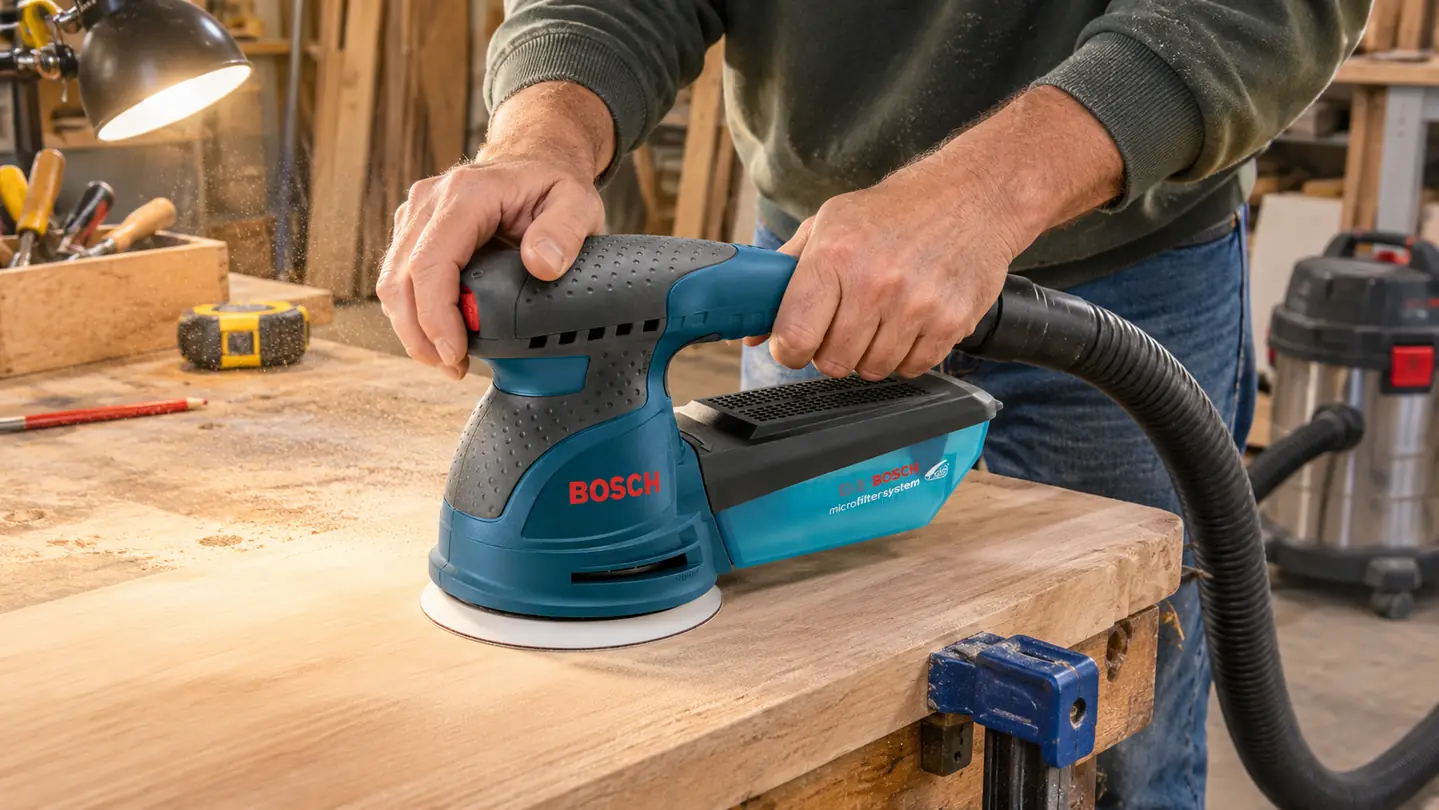
A palm sander moves its pad in small circles. That is orbital action, and it is genuinely useful, but the abrasive travels the same little loop thousands of times a minute, which means any scratch it starts, it keeps deepening in the same direction. The Bosch does two things at once. The disc spins. The whole pad also orbits. Because those two motions are not synchronized, each grain of abrasive takes a slightly different path on every pass, cutting in a direction it was not cutting in a moment ago. That is where a swirl free finish comes from. It is not a smoother motor or a better pad. It is geometry.
The numbers on this one are worth reading. The motor is 2.5 amp, 120 volt, corded, and the no load speed range runs from 7,500 to 12,000 orbits per minute. The VSC in the model name is the speed control, and I use it more than I expected to. On pine, where the wood is soft and a coarse disc can gouge in a heartbeat, I run it slow. On a hardwood top where I am only knocking down the last of the plane marks with 220, I open it up. A single speed sander makes that decision for you, and it usually makes it wrong.
Dust is the other half of the job. The canister on this sander uses a micro filter system that Bosch rates for particles down to a half micron, and there is a vacuum hose adapter in the box, along with a soft backing pad, a sanding disc, and a contractor bag. I run the adapter to the shop vac on the cart for big jobs and leave the canister on for small ones where dragging a hose across the bench is more trouble than it saves. Sanding without dust control is not a finish problem. It is a breathing problem, and I spent enough years in crawl spaces to care about that now.
Where Bosch Wins
Wide, flat work is the whole reason this tool exists. A tabletop, a chest lid, a glue up of four maple strips for a cutting board, a door panel, a shelf board. On those surfaces the Bosch does in one pass what the palm sander needs three passes and a lighter hand to do, and it leaves a surface that reads flat under a raking light. I keep a 60 watt bulb on a cord for exactly that check. Hold it low and across the grain and every swirl mark shows up like a fingerprint. The palm sander always left a few. The Bosch leaves none I can find.
It also wins on dust and on speed control, and both of those sound like small things until you have sanded a whole set of shelf boards in a garage with the door shut in February. Dust capture to a half micron with the hose attached means I am not wearing a respirator for a job that should not require one, and the shop does not have a film of oak flour on every surface for a week afterward. The speed range means I can start slow on a softwood edge and not blow through the corner. And the pad dampening system earns its keep on the curved arms of an Adirondack chair, where a rigid pad would flatten the curve it is supposed to follow.
Where the Palm Sander Wins
Now the honest part. The Bosch has a five inch round disc, and a round disc cannot sand a square inside corner. Not badly. Not at all. The corner of a bookshelf carcass, the inside of a face frame, the recess where a rail meets a stile, the little gusset inside a small box. Those are palm sander jobs, and if you sell the palm sander to pay for the random orbit you will be standing there with a sanding block in your hand wishing you had not. I have done that. It is a slow way to learn the lesson.
The palm sander also wins on money, in two places. It costs less to buy, and it runs on quarter sheets torn from a full sheet of paper, which is the cheapest abrasive you can put on a tool. Five inch hook and loop discs are convenient and they are not free. If you sand a lot of rough, painted, or reclaimed stock where the paper loads up fast, that difference adds up over a few years of Saturdays. The palm sander is also the one I hand to someone else, or take along to a repair at my daughter's house, because it is small and it does not need a hose trailing behind it.
The flat panel sander I reach for first, every single time
Bosch ROS20VSC. 5 in. disc, 2.5 amp motor, 7,500 to 12,000 orbits per minute, micro filter canister rated to a half micron, and a vacuum hose adapter in the box. 4.6 stars across more than 5,000 reviews.
Amazon Check Today's Price on Amazon →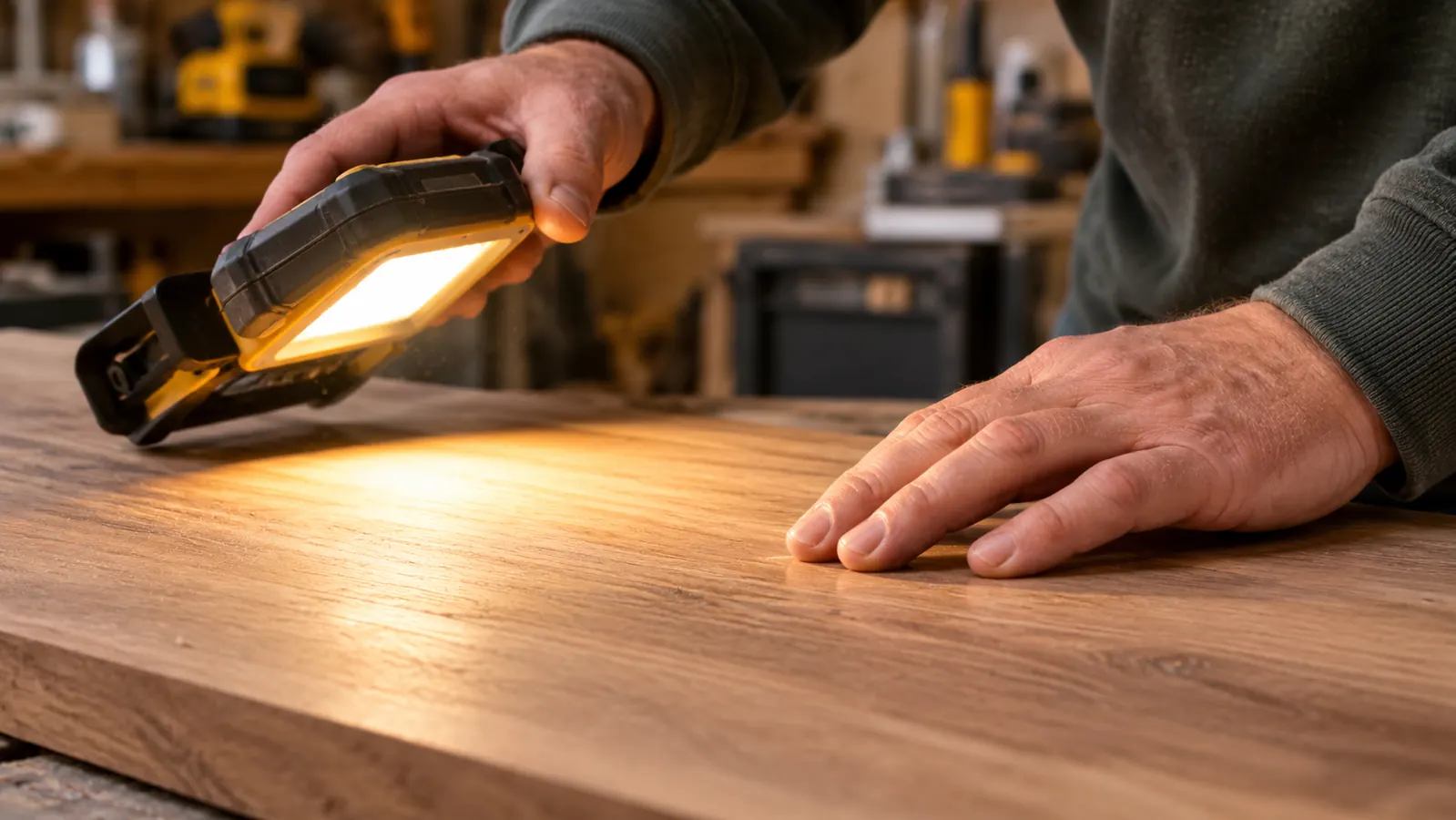
Paper, Pads, and the Ongoing Cost
One thing nobody tells you before you buy a random orbit sander: the paper is a subscription. Five inch hook and loop discs, in a range of grits. You will want 80, 120, 150, 180, 220, and probably 320. Buy them in packs, not singly, and buy more 120 and 180 than you think you need, because those are the grits doing the actual work. A disc gives up long before the edge is worn flat. When it stops cutting and starts polishing, change it. A tired disc on a random orbit is how you spend twenty minutes going nowhere and wondering why the finish will not come up.
The palm sander is the opposite economy. You buy full sheets, cut them into quarters on the bench with a utility knife and a straightedge, and one pack lasts a season. The clamp style is slower to change and the paper shifts if you do not seat it square, but it is hard to beat for the money. I keep a short stack of quarter sheets in a drawer under the bench next to the sanding block, and they come out for corners, for touch up, and for anything too small to be worth dragging the hose over to.
What I Have Actually Sanded With Each
A maple cutting board glue up is the cleanest test I know. Four strips, planed close, then sanded. With the Bosch and a 120 disc, then 180, then 220, I get a surface that takes mineral oil evenly and shows no cross grain scratches. The palm sander would get there too, given enough passes, but on end grain it wants to dig, and it left me chasing scratches around the board more than once.
The cedar chest was the other way around. The panels and the lid went to the Bosch. The inside of the carcass, the four corners where the sides meet, and the little step where the lid lip sits all went to the palm sander, because nothing else would fit in there. Same story on a bookshelf: wide shelves on the random orbit, inside corners and the back rabbet on the palm sander. Two tools, one project, and neither one is showing off.
The picnic table out back is where a random orbit sander really earns its keep. Weathered cedar, gray and rough, and I wanted it back to bare wood without dishing the surface. With a 60 disc and a light hand the Bosch flattened it, and the pad dampening kept the edges from rounding over the way a palm sander will if you lean on it. Took an afternoon. That table has been rained on for three years since and it still reads flat.
Under a raking light the palm sander always shows me a few swirls. The Bosch does not show me any, and that is the entire argument in one sentence.
What I Liked
- Random orbit action plus pad dampening keeps swirl marks off flat panels
- Micro filter canister rated to a half micron, and a vacuum hose adapter comes in the box
- Speed control covers 7,500 to 12,000 orbits per minute for softwoods and hardwoods alike
- The 5 in. disc covers wide panels fast
- 3.5 pounds and 9 by 5 by 6 inches, so it stores on a shelf under the bench
Where It Falls Short
- A 5 in. round disc cannot reach an inside corner
- 5 in. discs cost more than quarter sheets and you go through a lot of them
- Corded, so there is a cord and often a hose to manage
- 3.5 pounds gets heavy when you are sanding overhead or working a vertical panel
Who Should Buy Which
Buy the Bosch ROS20VSC first if your work is furniture, shelves, tabletops, boxes, or anything that comes down to a flat panel that has to look right under a finish. That is most of what leaves a garage shop, and it is the tool that makes the difference between a project that looks homemade and one that looks made. If you are building cutting boards, a cedar chest, a picnic table, or a run of shelves, this is the sander doing the visible work, and there is no substitute for it in that job.
Keep or buy a quarter sheet palm sander if your projects have inside corners, if you do repairs and small parts, or if you want a second sander that needs no hose and can be carried into the house. It is also the sensible only sander if the money available covers one tool right now and the job in front of you is a face frame. Just know what you are getting. A palm sander is a corner tool that can also sand a panel slowly. A random orbit is a panel tool that cannot sand a corner at all.
Start with the sander that handles the panels
If most of your work is flat, wide, and headed for a finish, the Bosch ROS20VSC is the one to buy. Speed control, dust capture rated to a half micron, and a pad that follows a curve instead of flattening it.
Amazon Check Today's Price on Amazon →