
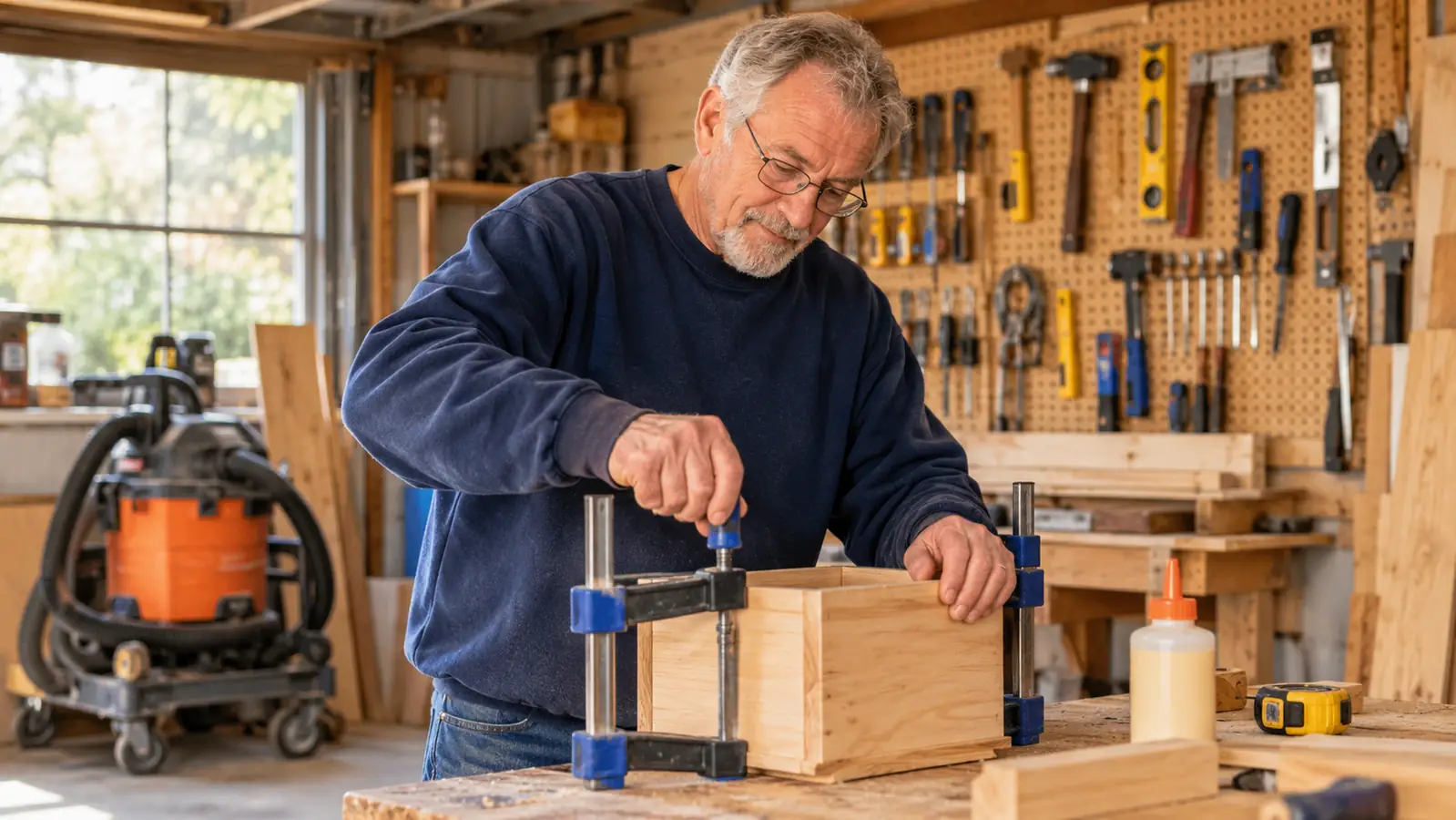
Short answer: for the glue-ups that fill my weekends, the IRWIN Quick-Grip 6-inch mini bar clamps are the ones I reach for, and the F-style clamps stay on the pegboard until a panel gets wide enough to need them. That is not a knock on F-style clamps. It is a statement about what most glue-ups actually ask for, which is a modest amount of pressure applied fast, in a spot where your other hand is already busy holding a joint square.
I have a converted two-car garage outside Richmond, one bay for the shop and one for the truck, a workbench I built before anything else, and a pegboard that has carried the same four F-style clamps for years. They are good clamps and I am not selling them. They are simply the wrong tool at 9 p.m. when you are gluing four mitered corners on a small box and the glue is already starting to grab.
| IRWIN Quick-Grip 6 in. | F-Style Clamp | |
|---|---|---|
| Reach into the work | 6-inch clamp, comfortable on stock a few inches wide | Sold in long bar lengths, so reach stops being the limit |
| Hands required | One. The trigger sets and releases the clamp | Two, one to hold the bar steady and one to turn the screw |
| Clamping force | 140 pounds | A screw handle turned by hand will out-pull any trigger |
| Speed on a small glue-up | Jaw on, squeeze, done in a couple of seconds | Spin the handle down to the work, then tighten |
| Working in a tight corner | Small body fits inside drawer boxes and face frames | Long bar and handle want room to swing |
| Long panel edges | You run out of clamp before the panel runs out of seam | The reason long bar clamps exist |
| Weight in the hand | Light enough to hold in place while you line up a joint | Heavier, with handle leverage working against your wrist |
| Best for | Boxes, small frames, jigs, repairs done alone | Tabletops, casework, anything wide |
Read the middle of that table and the split makes sense. One column is about force and reach. The other is about speed and hands. Almost every glue-up in a garage shop is decided by the second pair, because the joints are small and the open time is short. The wide panels that want real tonnage come along a few times a year, and for those the F-style clamps are the right answer and always will be.
The Box That Made Me Stop Fighting My Clamps
A couple of winters back I built a small walnut and maple box for Carol to keep tea in. Four mitered corners, glue on eight mating faces, and about ninety seconds before the joints start to stiffen. My F-style clamps wanted two hands each: one to hold the bar and keep the corner from sliding, one to spin the screw handle down until it bit. By the time the second clamp was on, the first corner had crept, and I spent the rest of the glue-up chasing the joint instead of closing it.
The box was eight inches long, five wide and four deep, with quarter-inch sides, and the mitered corners were the whole point of the exercise. I cut them on the table saw with a sled, checked every one against a square, and they closed clean on a dry fit. What I had not thought through is that a dry fit lets you hold two pieces with two hands while you look at the seam. With glue on eight faces you get one piece of stock in each hand for about four seconds, and then you need a clamp right now. I tried masking tape first, pulling the corners closed the way people do on mitered boxes. It held the shape but it did not pull the joint tight, because tape pulls along the surface and not across the two faces.
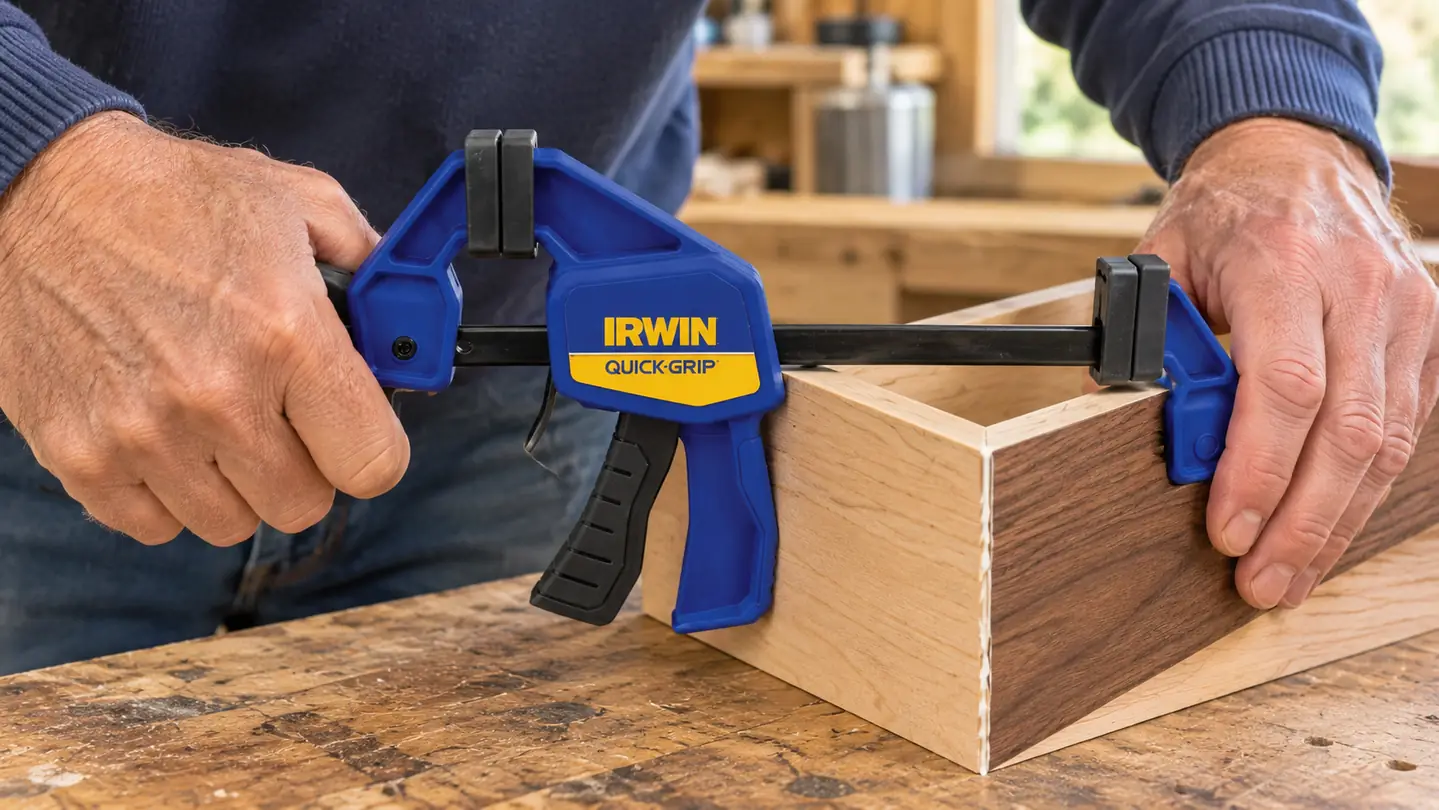
The IRWIN clamps changed that job in a way that felt almost unfair. You set the jaw against the work, squeeze the trigger with the same hand that is holding the clamp, and the joint closes. The other hand never leaves the corner. Four of them, one per corner, and the box was closed and square before the glue had time to do anything except squeeze out at the seams.
A 6-inch clamp with a trigger closes a joint while your other hand is still holding the pieces square. That is the whole argument, and it is a good one.
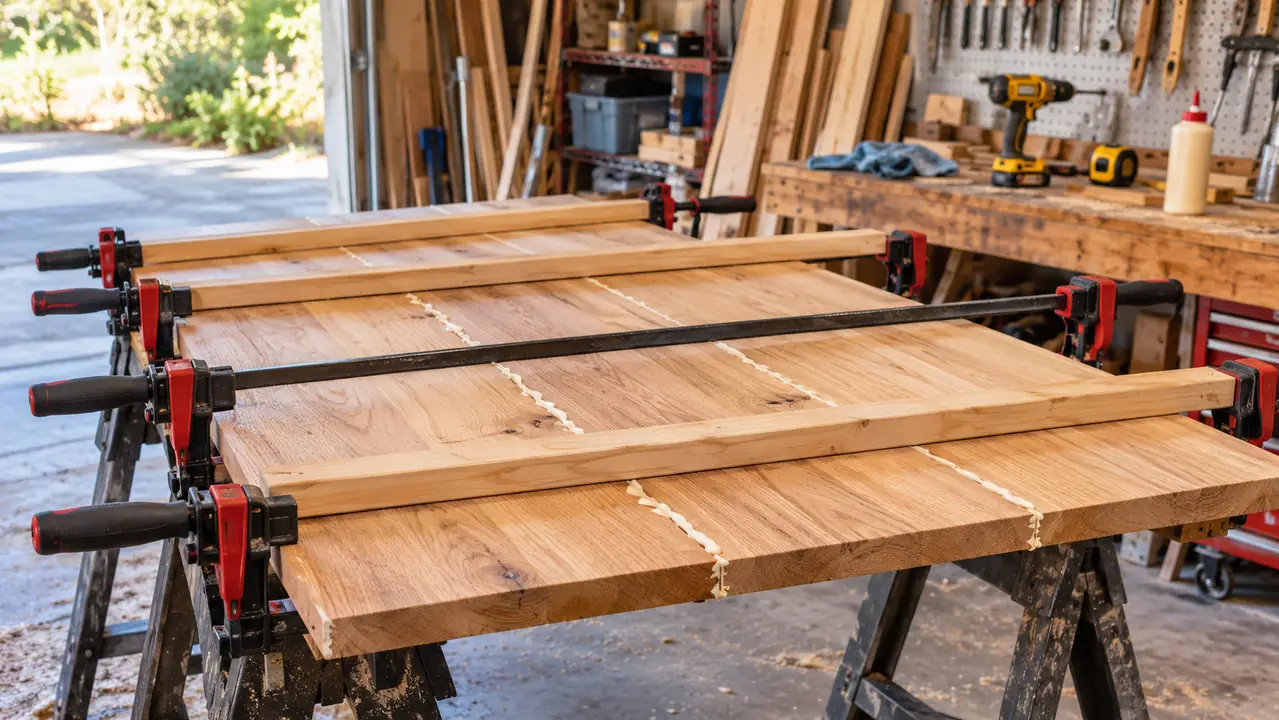
None of that makes the F-style clamp obsolete. A month later I glued up a picnic table top, three boards edge to edge, and the mini clamps were useless past the first few inches of seam. Out came the long bars, the screw handles, and both hands, and that is exactly what the job wanted.
Where IRWIN Quick-Grip Wins
The one-handed trigger is the whole reason these clamps exist, and it is the reason they live on my bench instead of in a drawer. When you work alone, which is most of us, every glue-up is a staffing problem. You need a hand on the joint, a hand on the clamp, and a third hand for the caul or the square. The Quick-Grip gives one of those hands back. It releases just as fast, one squeeze, and that matters more than people expect when you are checking a corner for square and need to open it a hair and close it again.
I used them last spring on a run of shop drawers, four boxes from half-inch ply with dadoed sides. A drawer box is the exact shape a long bar clamp hates, because the bar has to run through the opening and the handle wants to swing into the bench. The minis sat down inside the box, one across each corner, and I assembled all four in an evening. With the F-style clamps I would still be on the second one, and I would have knocked a corner loose at least once reaching over the bar.
The second win is size. The 6-inch clamp has a small body that gets between rails, into drawer boxes, and around the inside corners of a face frame where a long bar will not stand. Resin construction with hardened steel bars keeps it from flexing under load, and 140 pounds of force is more than a small joint of walnut or maple needs. The four-pack matters too. Four clamps is what a box or a small frame actually takes, and buying them as a set means you are not one clamp short at the worst possible moment.
Where F-Style Clamps Win
F-style clamps win on force and reach, and they win it without much of a contest. A screw handle turned by hand will pull harder than any trigger, and it will hold that pressure while you walk away and let the glue cure. When you are gluing three boards into a tabletop, you need clamps that span the full width and keep pulling after the glue starts to lubricate the joint. Mini bar clamps run out of bar long before a tabletop runs out of seam.
They also give finer control at high pressure. Turning a handle a quarter turn at a time lets you feel a joint come together and stop before you starve it. On a panel glue-up with cauls laid across the top, that feel is worth something. And an F-style clamp does not care how wide the work is or how awkward the reach, which is why they are still the standard for casework and anything built from dimension lumber.
What 140 Pounds of Force Actually Buys You
Clamping force gets talked about as if more is always better. It is not. What a glue joint wants is enough pressure to bring the two faces into full contact and hold them there while the glue sets, with a thin line of squeeze-out along the seam. Too little and you get a glue line that fails later. Too much and you starve the joint, which fails sooner. For the small joints the Quick-Grip is built for, 140 pounds is comfortably on the right side of that line.
Here is how that played out on an end-grain cutting board I made in February, eight by twelve inches, six strips. I clamped it with four minis across the width and got an even, unbroken squeeze-out line on both faces, which is what you want to see. The strips came out of the clamps flat. A year earlier I had built a similar board with two F-style clamps and overtightened one end, starved that seam, and left a line that showed up again months later once the board was in daily use at my daughter's house. Same glue, same wood, different pressure applied by a different pair of hands.
Where the number stops being enough is surface area. Force spread across a four-inch seam is plenty. The same force spread across a thirty-inch tabletop seam is not, and no clamp fixes that by trying harder. If you find yourself wanting to overtighten a mini bar clamp on a wide panel, that is not a clamp problem. That is a signal you picked the wrong clamp for the job.
The jaws deserve a mention for finish work. The listing says the clamps grip firmly and protect the workpiece from scratches and scuffs, and on planed maple that held true for me. I still keep scraps of cork around for anything with a finish already on it, because clamping a finished surface is always a risk, but on bare stock these left less of a mark than the steel jaws of an F-style clamp.
How They Hold Up in a Working Shop
A clamp either survives a garage floor or it does not. Mine get dropped, kicked off the bench, and buried under offcuts, and the resin bodies have taken it without cracking. The hardened steel bars have stayed straight, which is the part that actually matters, because a bar with a bend in it clamps crooked and pulls a joint out of square. The four-pack weighs 454 grams, so a whole set hangs on two pegboard hooks without dragging them out of the wall.
The first winter I had them, one got knocked off the bench onto the concrete while I was reaching for a caul, and I found it a week later under a pile of offcuts. The body was fine and the bar was fine. What it had collected was grit, and the trigger went from smooth to scratchy until I blew it out with the shop vac and worked a drop of dry lubricant into the slide. That is the whole maintenance routine these need: keep the bar clean, keep the trigger dry, and do not store them where the vac hose drags them around. I wipe the bars down with a rag before they go back on the hook, which costs ten seconds and keeps the clamp sliding the way it did out of the package.
The full lifetime guarantee is worth noting, not because I have needed it, but because it tells you what the maker expects. What wears first is the grip surface, and after a few years of steady use you will want cork or leather pads on the jaws for finished work. Store them off the concrete if you can. A clamp that lives on the floor collects dust in the trigger and starts to feel gritty.
What I Liked
- One hand sets and releases the clamp, so you can hold a joint square with the other
- Small body reaches inside drawer boxes, face frames and tight corners
- 140 pounds of force is plenty for boxes, jigs and small frames
- Four-pack covers all four corners of a small glue-up
- Resin construction with hardened steel bars resists flexing under load
- Backed by a full lifetime guarantee
Where It Falls Short
- The 6-inch bar runs out fast on anything wider than a few inches
- Not enough force for a wide panel glue-up
- The trigger gives no fine adjustment at the top of its range
- You will still need long F-style bars for casework and tabletops
The four clamps I keep on the bench, not in the drawer
Four 6-inch one-handed clamps, 140 pounds of force, a trigger that sets and releases with the same hand. If your glue-ups are boxes, frames and jigs, this is the set that ends the third-hand problem.
Amazon Check Today's Price on Amazon →Who Should Buy Which
Buy the IRWIN Quick-Grip four-pack if your glue-ups look like mine most weekends: small boxes, cutting boards under a foot, drawer boxes, face frames, shop jigs, and repairs where you are working alone and cannot let go of the joint. Buy F-style clamps if you build panels, tabletops, cabinet carcasses, or anything where the seam is longer than your hand. Most garage shops end up with both, and the honest split for me is four minis to two long bars.
If you only build small work, the four-pack is close to a complete clamp collection, and the F-style bars can wait. If you only build big work, skip the minis and spend the money on bar length. The trouble comes when you buy one kind and expect it to do both jobs, which is how a person ends up leaning on a 6-inch clamp with both hands, watching a tabletop seam open up.
Start with the set that solves the third-hand problem
Four 6-inch one-handed clamps with 140 pounds of force and a trigger that releases instantly. Add long F-style bars when a tabletop shows up, not before.
Amazon Check Today's Price on Amazon →