

There is a version of this review that goes like this: the Bosch ROS20VSC is a five-inch random orbit sander with a 2.5 amp motor, a no-load speed range of 7,500 to 12,000 orbits per minute, and a micro filter dust canister that traps particles down to half a micron. Every one of those numbers is on the box and every one of them is accurate. None of them is the part you actually learn in a garage.
What you learn is that a sander is a tool you hold for twenty minutes at a stretch with your fingertips, and everything about it that reads fine on a spec sheet gets re-read by your hands, your ears, and your lower back. I have run this Bosch through thirty-odd cutting boards, a set of maple shelves, a picnic table, four Adirondack chairs, and a cedar chest that took me two winters to finish. Here is the accounting, including the parts I would hand back if I could.
The Quick Verdict
A well-damped, well-mannered five-inch random orbit sander that will not fight you and will not quit. The dust canister is small, the carry bag is soft, and the round pad will never reach an inside corner.
Amazon Check Today's Price →The Sander That Has Stayed on My Bench for Four Years
Five-inch pad, 2.5 amp motor, variable speed from 7,500 to 12,000 orbits per minute, and a dampening ring that keeps swirl marks out of the finish. Read the full list of tradeoffs below, then check today's price on Amazon.
Amazon Check Today's Price on Amazon →How I've Used It
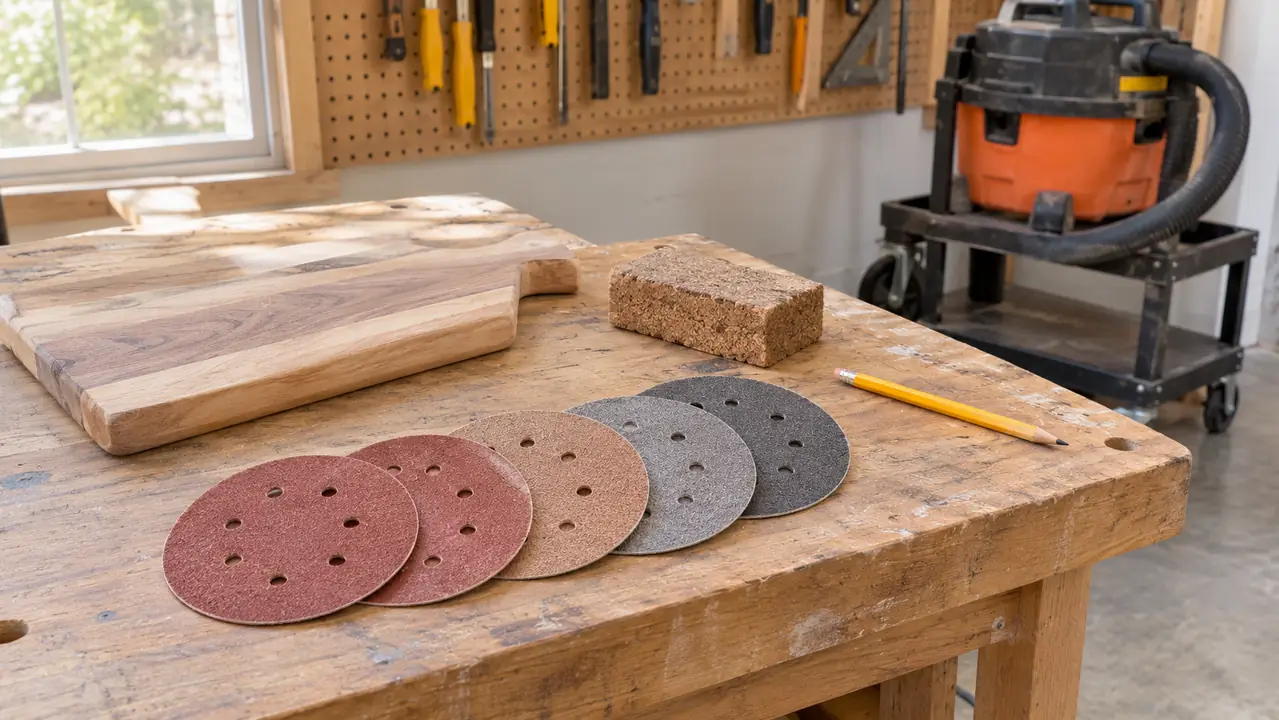
My shop is one bay of a two-car garage outside Richmond, Virginia. Concrete floor, a pegboard wall, a shop vac on a cart I roll wherever the dust is, and a 20-amp circuit I ran myself back when I was still pulling wire for a living. It is not a cabinet shop and I am not a cabinetmaker. The work that comes off my bench is cutting boards, small boxes, shelving, outdoor furniture, and the occasional piece that takes longer than it should because I keep changing my mind about the joinery.
The Bosch came into that shop as a second sander, not a first. I had been using a quarter-sheet palm sander that weighed about two pounds and left a pattern you could read like a topo map if you leaned on it in one spot. The five-inch random orbit was supposed to solve that, and mostly it did. The places where it did not are the reason this review exists, because the praise is easy and the honest part takes longer.
It has flattened cutting boards in maple, walnut, and cherry. It knocked the mill marks off a stack of cedar for the chest. It spent a long Saturday on the arms of Adirondack chairs where a spindle sander would not fit and a block would have taken me until dark. Roughly four years of weekend use, and it still starts on the first press. That is the first thing I want to say and the last thing I want to overstate, because plenty of tools start on the first press and still manage to be the wrong tool.
Where It Genuinely Earns Its Keep
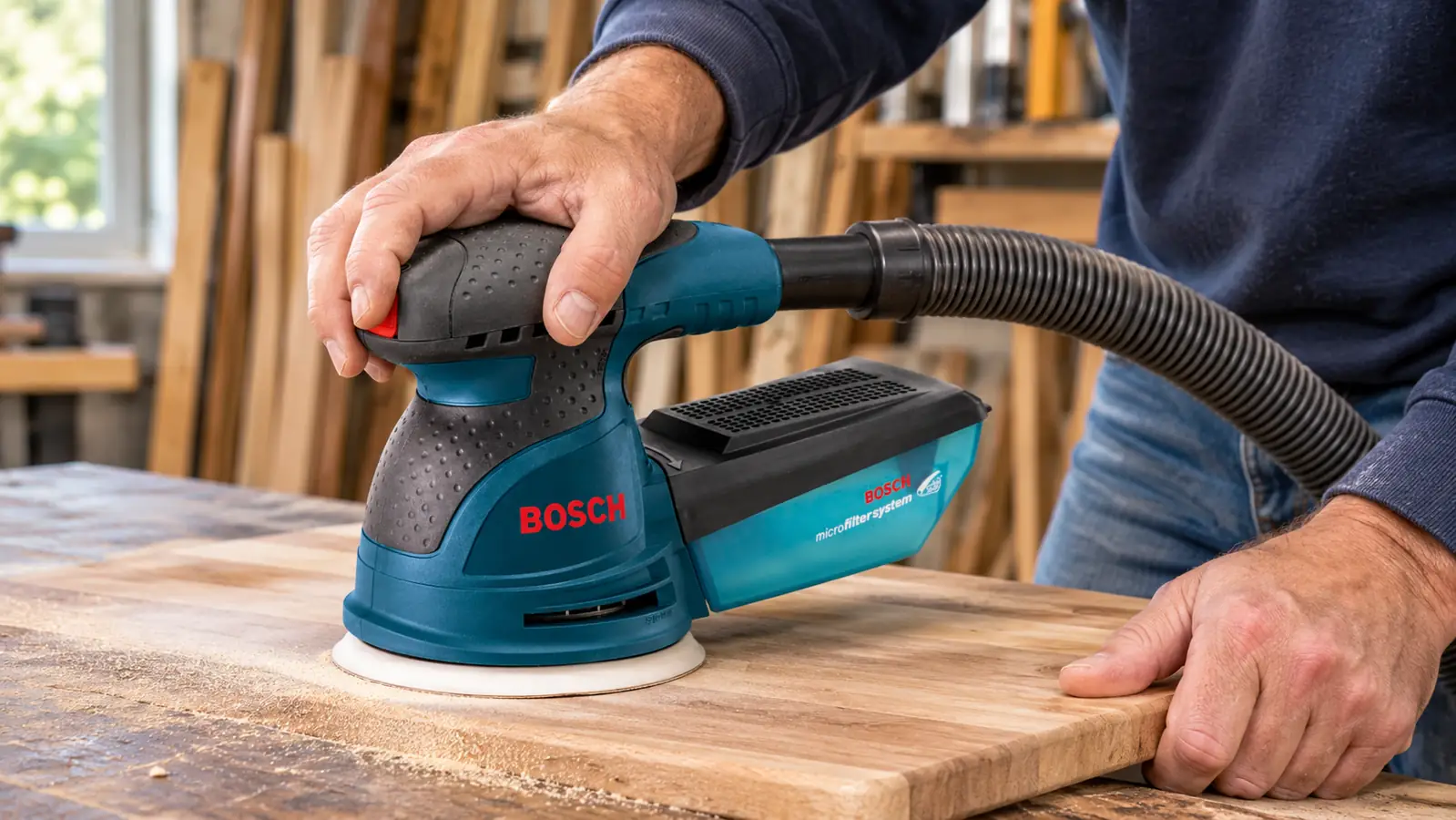
The pad dampening system is the feature that changes your work rather than your mood. Bosch builds a dampening ring into the pad, and its job is to break up the circular signature that a random orbit sander would otherwise print into the surface. On flat panels the difference between this and a bargain orbit sander is not subtle. Working a maple board through 80, 120, 150, and 220 grit, I got a surface that took mineral oil evenly and did not show the small pigtail swirls I used to chase out with a card scraper and bad language.
The other place it earns its keep is contoured work. The listing says the dampening is designed for flat and contoured surfaces, and my hands agree with the listing. On the curved arms of Adirondack chairs and along the eased edges of a routed handle, the pad gives just enough to follow the shape without digging in. A hard pad on a cheaper sander would have cut a flat spot across the crown of that arm, and I would have been taking the whole piece back down to bare wood to fix a mistake that took half a second to make.
Variable speed matters more than I expected it to. The range runs from 7,500 to 12,000 orbits per minute, and the low end is where I live for anything thin or veneered or already close to finished. The high end is for hogging mill marks off rough cedar when nobody is watching and the board is going to get planed anyway. Being able to drop the speed for a delicate pass is the difference between a tool you trust near a finished face and one you keep on the far side of the shop.
The body is 9 inches long, 5 inches wide, and 6 inches high, at 3.5 pounds. That is small enough to hold with one hand while you hold the workpiece with the other, which sounds like a minor thing until you are sanding a shelf side that will not sit still. I have clamped plenty of pieces that a slightly bigger tool would have let me leave loose.
Where It Falls Short
The dust canister is the biggest compromise, and it is the one I hear least about from people reviewing this thing. It is a small canister with a micro filter, and the filter does what the listing claims: it catches fine dust down to half a micron. What the listing does not tell you is how often you empty it. Sanding one cutting board, 12 inches by 18 inches, at 80 grit, I empty it twice. Do that arithmetic across a picnic table and you will understand why mine spends most of its life on the end of a shop vac hose.
That is not really a design flaw. It is a size decision made to keep the tool at 3.5 pounds and compact enough to fit under your hand. A bigger canister means a heavier, taller sander. But if you are planning to sand in a spare bedroom without a hose, you are going to be disappointed, and nobody at the counter is going to tell you that before you buy.
The vacuum adapter, though, is the good half of this story. It ships in the box, it fits a standard shop vac hose, and once you use it you will not go back to the canister for anything larger than a picture frame. Bosch got that part right and I would rather have a working adapter than a bigger plastic cup.
The second shortfall is smaller. The contractor bag that comes with the tool is a soft bag, not a case. It carries the sander and the adapter and it does that fine, but it offers no protection and it will not organize paper. Mine ended up in a drawer within a month and the sander lives on a shelf. Not a reason to walk away, just not the hard case a tool at this level ought to ship in.
Third, the switch sits somewhere other than where my thumb expects it after twenty years of other sanders. It is not a bad switch. It is a different one, and I have reached for it in the wrong place often enough to write it down. Every sander I have owned has had one of these, every one of them is in a different spot, and I complain about all of them equally.
Fourth, it is corded. There is no battery option and that is an honest trade rather than an oversight. A 2.5 amp motor pulling through a cordless platform would either be heavy or short-lived or both. But it does mean a cord dragging where you do not want it and an outlet that has to be within reach. In a garage with one bay and a circuit on the wall, that is nothing. On a ladder with no power nearby, it is everything.
Setup, Paper, and the Cost of Convenience
The five-inch disc is the right size. Paper is available everywhere in every grit from every maker, and the hook and loop pad holds it flat. In the box you get the soft backing pad, one sanding disc, the dampening ring, the dust canister, the vacuum hose adapter, and the bag. That is a complete starting kit and nothing extra, which is honest of them, and it also means your first real paper purchase happens the same week you unbox it.
Changing paper is a two-second job and I do it more than I change any other consumable in the shop, which is the whole argument for hook and loop over adhesive discs. The backing pad has held up. Four years in and I have not replaced it, though I keep the tool off the bare concrete and that is most of the reason. Set it down pad-first on a gritty floor a few dozen times and you will be buying pads.
One thing worth planning for: this is a stock removal tool that can also finish, not a finish sander that can also remove. If you try to take a rough board to a finished surface with it and nothing else, you will spend an hour and burn a stack of paper. Do the honest thing, work the grits in order, and it moves fast and the surface comes out clean. The tool rewards sequence and it punishes shortcuts, which is a fair way for a tool to behave.
Sanding one cutting board at 80 grit, I empty the canister twice. Do that arithmetic across a picnic table and you will understand why mine lives on the end of a shop vac hose.
Vibration, Sound, and What an Afternoon Feels Like
A sander that vibrates badly is a sander you stop using, and this is where the dampening pays off a second time. After forty minutes on a table top my hands are tired but not buzzing, and I can feel the difference between that and the old palm sander, which left my fingers humming through dinner. The 3.5-pound body helps here too. Weight you do not have to fight is weight you do not feel by four in the afternoon.
The noise is what it is. It is a sander with a universal motor and it makes the sound a sander makes. I wear muffs for anything over a few minutes and I would wear them with any tool on this bench. Nobody is buying this for the sound, and if quiet is your priority you should be reaching for a card scraper and a plane instead, which is a different and slower conversation.
How It Compares to a Palm Sander in the Hand
If you are coming off a quarter-sheet palm sander, the first thing you notice is the weight and the second thing you notice is that you no longer have to steer. A rectangular palm sander walks in the direction of the grain and you correct it constantly. A five-inch random orbit with a round pad stays roughly where you put it, and the work goes faster because you are sanding instead of wrestling.
The trade is reach. A rectangular palm sander gets into a corner. A round five-inch pad does not and never will, no matter how you hold it. I still own both. The Bosch does the field, the palm sander does the corners, and a cork block with a strip of paper does whatever neither one can touch. Anyone who tells you a single sander replaces all three either does different work than mine or has not sanded an inside corner since the last time they had to.
What I Would Change
If I could hand Bosch a short list, it would be three items. A canister that holds twice as much, even at the cost of a quarter inch of height. A switch placed where my thumb already goes. And a hard case in place of the soft bag, because the bag has not aged as well as the tool has. None of those are reasons to skip it. They are the reasons this is a very good sander and not a perfect one.
I have owned tools where the complaint list ran to a full page and I eventually sold them at a yard sale for whatever the first person offered. This one I keep, and I keep reaching for it first, which is the only endorsement that has ever meant anything in my shop.
What I Liked
- Pad dampening ring genuinely cuts swirl marks on flat panels and on curved work
- Variable speed from 7,500 to 12,000 orbits per minute covers both stock removal and finish passes
- 3.5-pound body with a compact 9 by 5 by 6 inch footprint stays controllable through a long session
- Micro filter traps fine dust down to half a micron, and the included adapter fits a standard shop vac hose
- Five-inch disc means paper is cheap and stocked everywhere
- Four years of weekend use and the backing pad still holds paper
Where It Falls Short
- Dust canister fills fast; expect two empties on one cutting board at 80 grit
- Contractor bag is soft and offers no protection for the tool
- Corded only, so an outlet has to be within reach
- Round five-inch pad cannot reach an inside corner
- Switch placement takes getting used to
- No hard case in the box
Who This Is For
This is for the person sanding in a garage or a basement with an outlet on the wall and a shop vac they were going to drag out anyway. It is for cutting boards, shelving, table tops, chairs, and small boxes, where the surface is flat or gently curved and the finish is the point of the whole project. If you build furniture for your own family and you want one sander that will take a board from rough to ready without leaving a pattern behind, this one does that and it will still be running in year three. The variable speed and the dampening ring are the two features that make it worth owning rather than borrowing.
Who Should Skip It
Skip it if you sand in a room you care about and you are not willing to hook up a hose. The canister is a supplement, not a solution. Skip it if your work is mostly inside corners and narrow trim, because a round five-inch pad is the wrong shape for that job and you will end up buying a detail sander within a month. Skip it if you need to work off a ladder or away from power, since there is no battery version and the cord is part of the bargain. And skip it if what you want is a finishing tool that removes nothing, because this one removes material quickly, and quickly is the entire point.
Four Years On, It Is Still the First Sander I Reach For
It has flattened thirty cutting boards and a set of maple shelves, and the pad still holds paper. If your shop is a garage with an outlet and a shop vac, this is the one to put on the bench. Check today's price on Amazon.
Amazon See Today's Price on Amazon →