
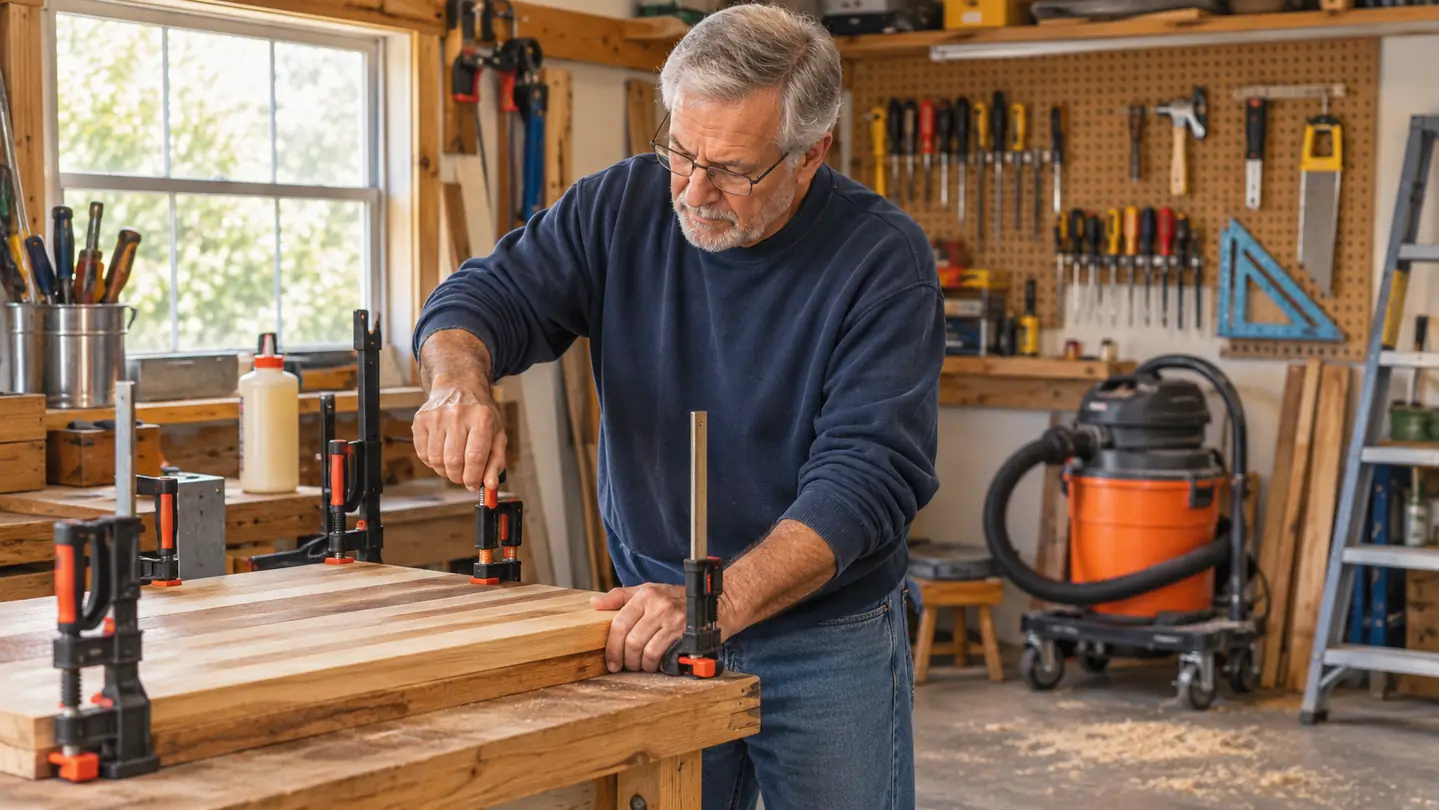
The first thing I did with the IRWIN Quick-Grip six-inch clamps was try to pull a warp out of a cedar board headed for a chest lid. They would not do it. I got the seam closed and the board stayed warped, and the clamp made it clear it was giving me everything it had. That is not a complaint. It is the most useful thing I can tell you, because the product page says 140 pounds of force, and 140 pounds sounds like plenty until you are standing at a bench asking a piece of wood to change its mind.
I am Gene Halvorsen, 63, retired out of commercial electrical work, and I have been building furniture in a converted two-car garage outside Richmond, Virginia for about 25 years. Cutting boards, small boxes, bookshelves, a cedar chest, Adirondack chairs, a picnic table, simple cabinets, and the workbench I built first and have rebuilt twice. My shop is one bay, concrete floor, a 20-amp circuit I ran myself, a shop vac on a cart, pegboard on the wall. I reach for small clamps more than any other clamp I own, and I have learned where these particular ones are the right tool and where they are not.
The Quick Verdict
A handy small clamp that earns its place on boxes, jigs, face frames and one-hand jobs in tight spots. It will not straighten a bowed board, and it is not a substitute for a long bar clamp on a panel glue-up.
Amazon Check Today's Price →The Clamp You Reach For When a Second Hand Would Help
Four six-inch one-handed clamps, a resin body over hardened steel bars, and a trigger that releases the tension so you can move to the next joint. This is the set that lives on my bench, not in a drawer.
Amazon See the IRWIN Quick-Grip Set on Amazon →What the Product Page Does Not Tell You
The listing is accurate as far as it goes, but it is written for a search engine, not for a person with glue on their fingers. It says 140 pounds of force in one bullet and then says the clamp will evenly distribute 150 pounds in the next. I have never put a gauge on one, so I cannot tell you which number is right. What I can tell you is that the number matters less than where you put the clamp and how many you use. Two clamps at the ends of a joint and none in the middle is how you get a gap in the middle.
The other thing the page does not say plainly is that these are small clamps. Six inches is a real limit. IRWIN calls them ideal for smaller workpieces and confined areas, and that is exactly right. They shine on a mitered box corner, a drawer front, a face frame, a jig, or a repair where your hand will not fit. They are not the clamps you buy for a tabletop glue-up. If you read the reviews and come away thinking four of these will handle a picnic table, you will be disappointed, and the clamp will get blamed for a job it was never built to do.
The listing also says the set includes four six-inch clamps and the whole four-pack weighs 454 grams, about a pound. That is light enough to hang on a pegboard hook without sagging it, and light enough that you forget you are holding one. Light is not the same as flimsy. The bars are hardened steel and the body is resin, and mine have been dropped and knocked and used as a temporary stop more times than I should admit. What the weight tells you is that these are for holding, not for forcing. A heavy clamp tells you it means business. These tell you they are here to help.
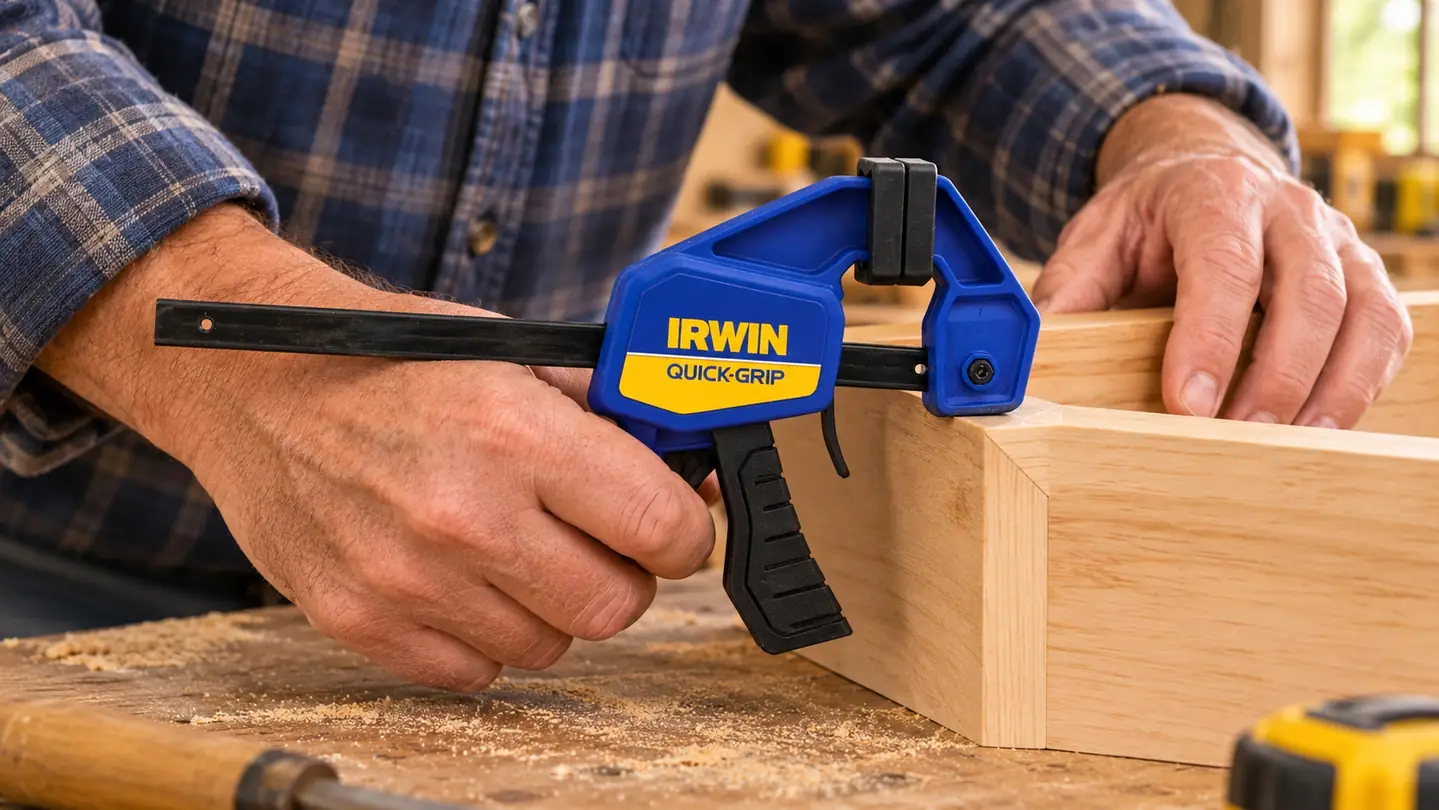
One more thing the page does not say. The clamping faces protect the work from scratches and scuffs, which is the claim in the listing and it holds. They also collect glue. Every clamp I own has a little crust on the faces, and these are no different. I keep a roll of packing tape on the pegboard and wrap the faces when I am gluing something that squeezes out. It takes ten seconds and saves twenty minutes of picking cured glue off with a chisel. That is not a flaw in the clamp. It is a habit that keeps the clamp working the way it should.
How I've Used Them
Small boxes are where these clamps make the most sense. I build a lot of them out of offcuts, and a box has four corners that all want to slide while the glue is wet. Four clamps, one per corner, and you can walk away. I set them so the bar runs on the outside of the box and the faces land on the sides, then check the diagonals with a tape before the glue grabs. With a bigger clamp, I am fighting the weight of the tool while I line up the joint. With these, I can hold the box in one hand and set the clamp with the other, which is the whole point of the design.
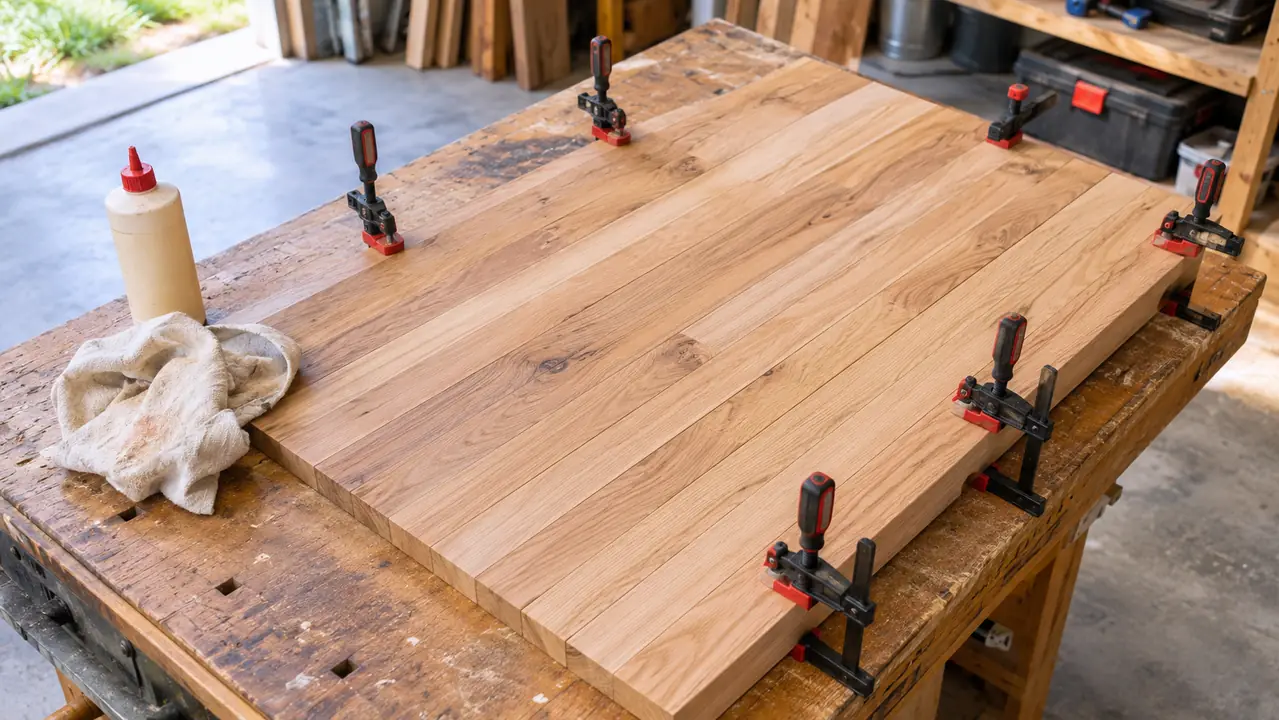
Cutting board glue-ups are the other regular job. I am not using these to pull a panel flat. I use them to hold the seams closed while the panel sits on a flat reference and I check for slip. Two or three of these along a short seam, plus a couple of longer clamps across the width, gets me where I need to be. The six-inch clamps are the ones that keep the ends from kicking out while I set the big ones. That is a small job, but it is the job that goes wrong if nobody is holding the ends.
I also use them for jigs and fixtures. A straightedge on a board, a stop block on a sled, a caul on a curved glue-up, a piece of scrap holding a drawer part while I drill it. The one-handed action is the reason they get reached for here, because I can position the piece, hold it, and set the clamp without asking Carol to come out and be a third hand. She has done that enough over the years, and I would rather she did not have to. The clamp does the job she used to do, and it does not get cold standing in the garage.
140 pounds will hold a joint closed. It will not talk a twisted board out of being twisted, and it will not pull a cup out of a wide panel.
The 140 Pounds, in Practice
Here is what 140 pounds feels like in a garage. On a clean joint with two flat faces and a bead of glue, it is more than enough. You snug the clamp, the glue squeezes out along the seam, and you stop. On a joint that is fighting you, a slightly twisted 2x4 or a board with a cup in it, the clamp runs out of travel and you run out of patience at about the same time. The bar is hardened steel and it does not flex much, but the whole tool is small. There is only so much leverage in a handle that fits in your palm.
The honest way to use them is to prepare the wood so the clamp does not have to do the work. Joint the edges, check them against a straightedge, and dry fit before the glue bottle comes out. If the joint needs a clamp to force it closed, the clamp is doing the job the jointer should have done. When I do that, four of these will handle a small box or a set of drawer parts without any drama. When I skip it, I am asking a six-inch clamp to fix a problem I created at the saw, and that never goes well.
I also want to say something about pressure distribution, because it is the part that gets skipped in every review I read. A clamp applies force at one point. Wood is not perfectly stiff. If you put one clamp in the middle of a twelve-inch seam, the ends will lift. Two clamps evenly spaced will do better than one clamp tightened as hard as you can. That is true of every clamp, and it is especially true of small ones, because the force is concentrated over a small face. The tool is not the whole answer. Placement is.
Where the Six-Inch Size Runs Out
Adirondack chairs are where I stop reaching for these. The arms and the back slats are wide, the joints are long, and the pieces are awkward to hold. You need reach and you need depth, and six inches gives you neither in the amounts that job wants. I use longer bar clamps for that work and keep these in the apron for the small stuff. The same goes for a picnic table top. A glue-up that wide needs clamps every few inches across the whole width, and a four-pack of six-inch clamps will not cover it. You would need a rack of them, and even then the reach would be wrong.
Panel glue-ups are the other place they run out. When I am gluing up a cutting board, the panel might be eighteen inches wide. The clamps have to reach across the width and hold the whole stack. Six inches will not do it. I use these on the ends to keep the strips aligned, and I use the long clamps for the actual pressure. That is a support role, and it is a useful one, but it is not the role people imagine when they buy a four-pack. If you are buying your first clamps for furniture, buy the long ones first. Add these later.
There is also the matter of how far the clamp has to reach past the edge of the work to get the faces on the board. On a wide panel, a small clamp will bottom out before the face touches. I hit this on cabinet face frames, where the stile is narrow but the rail is wide, and the clamp has to come in from the side. Sometimes it fits. Sometimes I have to switch to a different clamp or clamp from the other direction. It is not a defect. It is the geometry of a small tool, and you learn to see it before you start spreading glue.
The Trigger, the Clamping Faces and the Small Annoyances
The trigger release is the feature I use most and the one I would miss most if it went away. You squeeze it and the tension comes off, and you can slide the clamp back with the same hand. On a glue-up where you are moving from joint to joint, that saves real time. It also means you can set a clamp light, check the joint, and snug it without fighting a screw thread. The one-handed part is not marketing. It is the reason these clamps live on the bench instead of in a drawer with the others.
The annoyances are small but real. The release is quick enough that if you are careless, the clamp can let go before you have the joint supported, and the piece drops. I have done it. Now I set the clamp with the work flat on the bench and my hand under the joint. The faces also leave a faint impression on soft wood if you overtighten, which is true of any clamp with a smooth face. And the resin body does not love a concrete floor. I dropped one off the bench onto the slab and it survived, but I would not make a habit of it.
Storage is the last small thing. These do not stack as neatly as F-style clamps, because the handle is bulky and the bar is short. I keep four on a pegboard hook and the rest in a milk crate under the bench. If you leave them in a pile, the triggers get bumped and the jaws drift. That is not a reason to avoid them. It is a reason to give them a home. A hook on the pegboard solves it, and I say that as a man who has spent an hour looking for a clamp he set down thirty seconds ago.
What I Liked
- One-handed set and release, so you can hold the joint and run the clamp at the same time
- Four clamps in the pack, enough for a small box or a set of drawer parts
- Resin body over hardened steel bars holds up to normal shop use
- Clamping faces protect the work from scratches and scuffs
- Full lifetime guarantee from IRWIN
Where It Falls Short
- Six inches of clamp will not handle a panel glue-up or outdoor furniture
- 140 pounds of force will not straighten a bowed or twisted board
- The faces collect glue and need tape or wax paper on a glue-up
- Short bars and bulky handles make them awkward to store in a pile
What I Would Do Differently
If I were setting up my shop from scratch, I would buy two long bar clamps first and this four-pack second. That is the order that matches the work. The long clamps do the structural glue-ups, and the small ones do the detail work, the jigs, the repairs, and the holding. Buying the small ones first is what a lot of beginners do, because they are the ones that look manageable on a shelf. Then they get home, try to glue up a tabletop, and decide clamps are overrated. The clamps are fine. The order was wrong.
The other thing I would do differently is buy eight instead of four. Not because four is a bad number, but because a box with four corners and a lid is five clamping points, and you will always want one more. Two packs give you eight and cover most of the small work I do in a session. If you are only buying one pack, four is a fair start. Just know that the day will come when you are holding the fourth clamp and looking at an open corner, and you will wish you had a fifth. Every woodworker I know has had that day.
Who This Is For
This is for the hobby woodworker who builds small things and needs a third hand. Boxes, drawers, face frames, jigs, repairs, holding a straightedge, keeping a caul in place. It is for the person who works in a garage or a basement and does not have room for a wall of long clamps. It is also for the person who already owns the long clamps and wants a set that lives on the bench for the small jobs. If that describes you, the IRWIN Quick-Grip six-inch set will earn its place. It is a tool you reach for without thinking, which is the highest compliment I can pay a clamp.
Who Should Skip It
Skip it if your next project is a tabletop, a workbench top, a picnic table, or anything else with a glue-up wider than a foot. Skip it if you are looking for clamps to pull twisted lumber straight, because no clamp in this size class will do that and you will blame the tool. Skip it if you only buy one clamp at a time and expect it to cover everything, because a six-inch clamp is a specialist. And skip it if you are rough on tools and prone to using a clamp as a hammer. The resin body is tough, but the lifetime guarantee does not cover being used like one.
The Small Clamp That Earns Its Bench Space
Four six-inch one-handed clamps with a trigger release, hardened steel bars and faces that protect the work. Buy them for the small jobs and they will be the clamps you reach for every time a joint needs a second hand.
Amazon Check the IRWIN Quick-Grip Set on Amazon →