
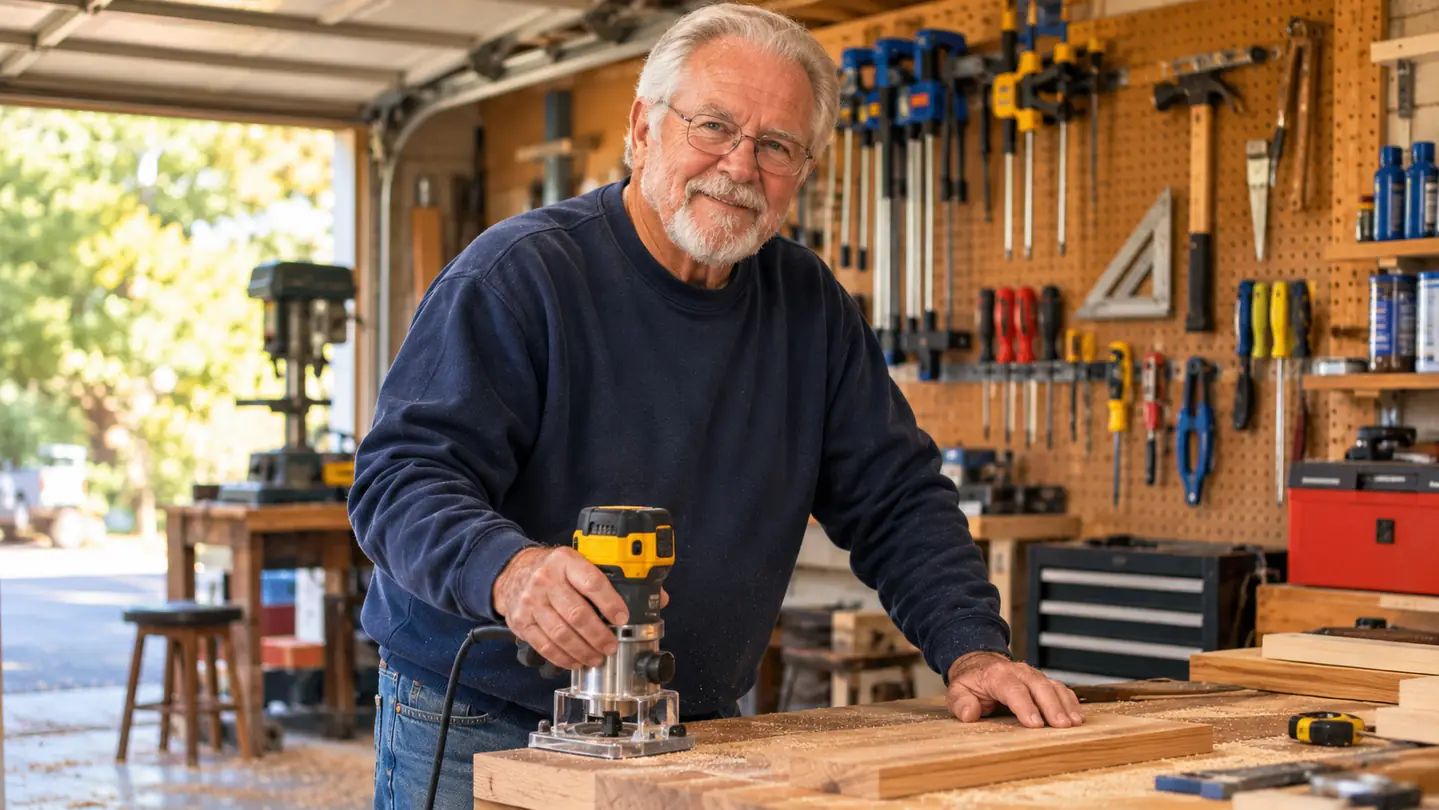
For about four years my only router was a two-horsepower model bolted to a plate in a table. It did everything I asked and complained about none of it, but every small job turned into a production. Clear the bench. Unbolt the plate. Find the wrenches. Dial the depth back in. By then the ten minute task had eaten an afternoon. What I needed was a router I could pick up with one hand, set on a cutting board, and put back on the shelf when I finished. That is the whole case for the Bosch PR20EVS Colt, and it is one I have made to myself about forty times since.
This is not a list copied off a box. It is the ten jobs in my garage that the Bosch Colt took over, roughly in the order I found them. If you build shelves, cutting boards, small boxes and the occasional Adirondack chair, most of these will look familiar.
Ten jobs, one small router, one drawer
The Bosch Colt weighs 3.3 pounds, runs a 1 HP motor, and its fixed base accepts bits up to 1-5/16 in. If your big router lives bolted in a table, this is the one that comes out for everything else.
Amazon See the Colt on Amazon →It puts a roundover on a cutting board in one pass
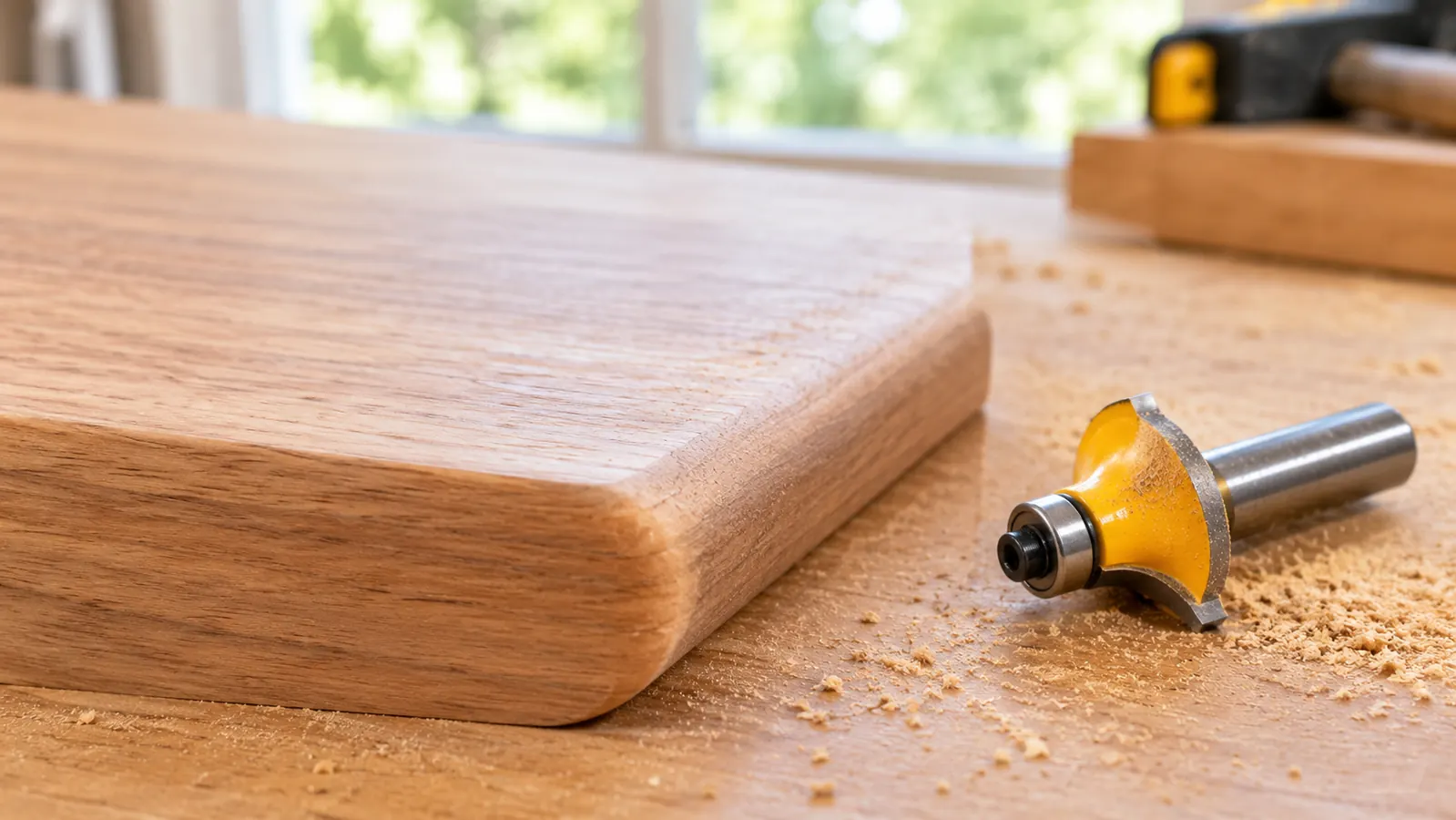
A cutting board is all edges, and edges are where a trim router earns its keep. With a 1/4 inch roundover bit in the Colt, I make one pass per edge, working the end grain first and the long grain after, and the corners come out even. The fixed base sits flat on the board face, so there is no tipping, and 3.3 pounds means I can hold the tool with one hand and guide the cord with the other. On walnut and hard maple I take two lighter passes and let the variable speed do the work instead of shoving the bit through.
It trims edge banding flush without a chisel
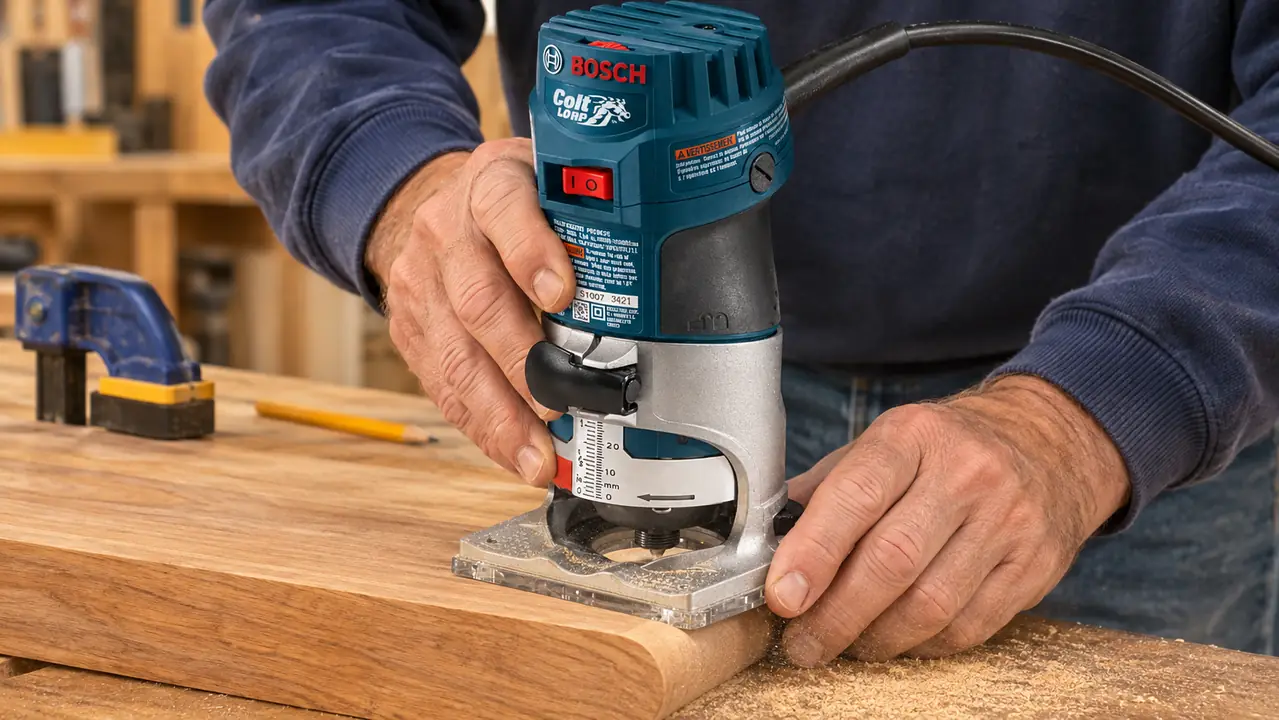
I build simple cabinets for the garage and the laundry room, and I band the plywood edges with solid strips. Before the Colt that meant a flush trim bit in the big router, which is top heavy on a 3/4 inch shelf, or a chisel and a lot of hoping. Now I set a pattern bit, run the bearing along the plywood face, and the banding comes flush in one continuous pass. The aluminum fixed base keeps the bit square to the face, which matters more on thin banding than on anything else I do.
3.3 pounds stays flat on narrow stock
Most of what I rout is narrow. Three inch rails, box sides, the edge of a cedar chest lid. A full size router on that stock is a wrestling match, and the moment the base hangs off the edge the bit tips. The Bosch Colt's body measures 3.75 inches wide by 7.5 inches tall with a 1.56 inch base diameter, so the base sits inside the footprint of the work and stays fully supported. I hold the motor in my right hand and feed the stock with my left. That sounds like a small thing until you have scrapped a lid learning it.
The macro and micro depth adjustment repeats
Depth is where cheap trim routers fall apart. You bump the body, the bit moves, and your second pass does not match your first. The fixed base on this Bosch uses a two-stage system, a macro ring for the bulk of the change and a micro adjuster for the last few thousandths. I set the bit to just kiss the workpiece, lock it, and make a test cut on scrap. When I come back the next weekend to finish the other three sides of a box, I can return to the same number. That repeatability is the difference between a tool you trust and a tool you fight.
Finger support pockets keep it level on edge work
This is a small molding detail on the base that I did not expect to care about. The base has finger support pockets, molded ledges where your fingers sit, and on edge work they give you a lower and more stable grip than wrapping your hand around the motor. When I rout the profile on a set of Adirondack chair arms, my hand sits down on the base instead of up on the barrel, and the cut stays level through the curve. It is the kind of thing that only shows up after an hour of continuous work.
I set the bit to just kiss the board, locked it, and came back a week later to the same cut on the other three sides of the box.
Soft-start takes the grab out of a small bit
A router with a 1/4 inch bit spinning at 16,000 rpm or better wants to walk the moment it starts. This Bosch uses soft-start circuitry, which ramps the motor up instead of slamming it straight to speed, and on a small bit in a shallow cut you feel the difference in the first inch. I start the motor with the base flat on the work and the bit clear, let it come to speed, then move. In all the edges I have run with it, it has never jumped on me. A router that grabs will take a chip out of a finished top, and you will not get that back.
1 HP and 16,000 to 35,000 rpm handle hardwood if you do not rush
One horsepower is not a lot, and I will not pretend it is. In white oak and hard maple, a deep cut with a large bit will bog the motor and burn the edge. What works is lighter passes. Set the variable speed to a middle range for a wider bit, take an eighth of an inch at a time, and keep the router moving. Do that and the Colt cuts clean through everything I build with. Try to hog a 3/4 inch groove in a single pass and you will hear the motor labor, which is your warning to back off.
The fixed base takes bits up to 1-5/16 inch
The enhanced bit capacity of the fixed base means it accepts bits up to 1-5/16 inch in diameter. That covers every roundover, chamfer, flush trim, slot cutter and small pattern bit in my drawer, plus a straight bit I use for stopped grooves in box sides. It is not a panel raising router and it never will be. But the range between a small roundover and a straight bit is most of what a garage shop actually cuts, and the Colt covers all of it with the 1/4 inch self-releasing collet it ships with.
It fits in a drawer, so it actually comes out
The Colt is 3.75 inches wide and 7.5 inches tall and weighs 3.3 pounds. In practice that means it lives in the second drawer of my bench, not in a case on a shelf behind the shop vac. Tools that need unpacking do not get used. When Carol asks for a shelf, I pull the Colt out, rout the edge, and put it back before the sawdust settles. The big router stays bolted in the table where it belongs, and I have stopped unbolting it for jobs it was never suited to.
It is a second router that does not fight the first one
The best argument for the Colt is not that it replaces a full size router. It is that it lets the full size router stay set up. My table router keeps a straight bit and a fixed fence, dialed in for grooves and dados. The Bosch handles every freehand edge in the shop. Two routers, two jobs, no swapping bits and re-dialing depth in the middle of a project. If you are still pulling one router out of a table for every small cut, this is the change that saves the most time.
What I'd Skip
If you need to raise panels, cut tenons in thick stock, or run a large raised panel bit, the Colt is the wrong tool and no amount of technique will fix it. It is a 1 HP palm router with a fixed base and a 1/4 inch collet, and no plunge base comes in the box. I would also skip it if you only build with sheet goods and a track saw, because you may never need a freehand edge. And if every routing job you have happens upside down in a table, put the money into a bigger motor instead. The Bosch Colt is for work you do holding the tool in your hands, with the work clamped to the bench.
Start with the edges you already cut
A roundover on a cutting board. Flush trim on a banded shelf. A chamfer on a box lid. If those are in your week, the Colt is the router that gets them done without clearing the bench first.
Amazon See the Colt on Amazon →