
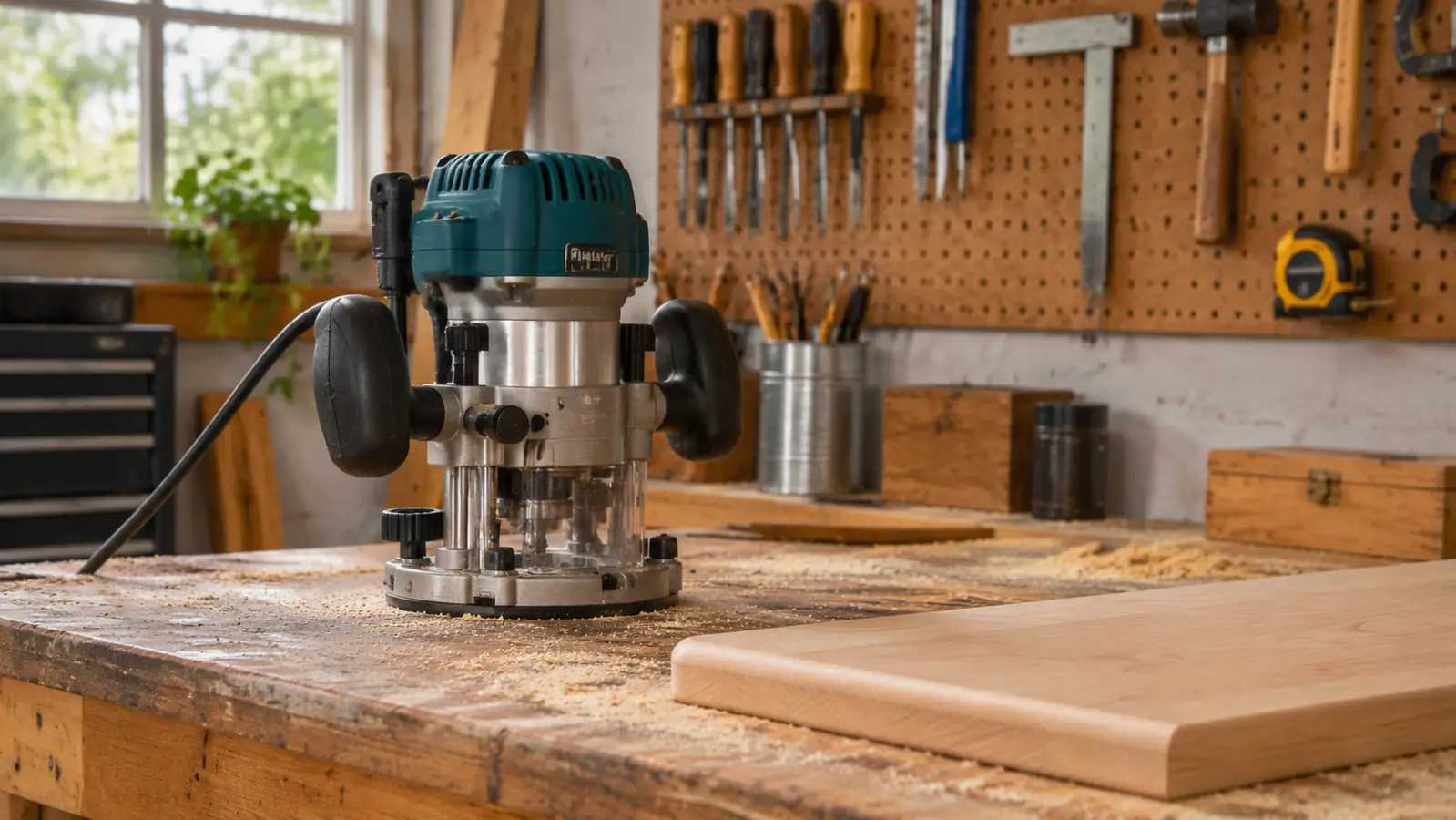
Every few months somebody leans on my workbench, picks up the Bosch Colt PR20EVS off the pegboard, and asks why I still bother with a cord. It is a fair question. Cordless tools have gotten good enough that the cord is usually the last thing left to argue about, and a palm router is exactly the kind of tool that seems like it should not need one. Then we edge a length of maple together and the argument sorts itself out. Some days it sorts out in favor of the Colt. Some days it does not.
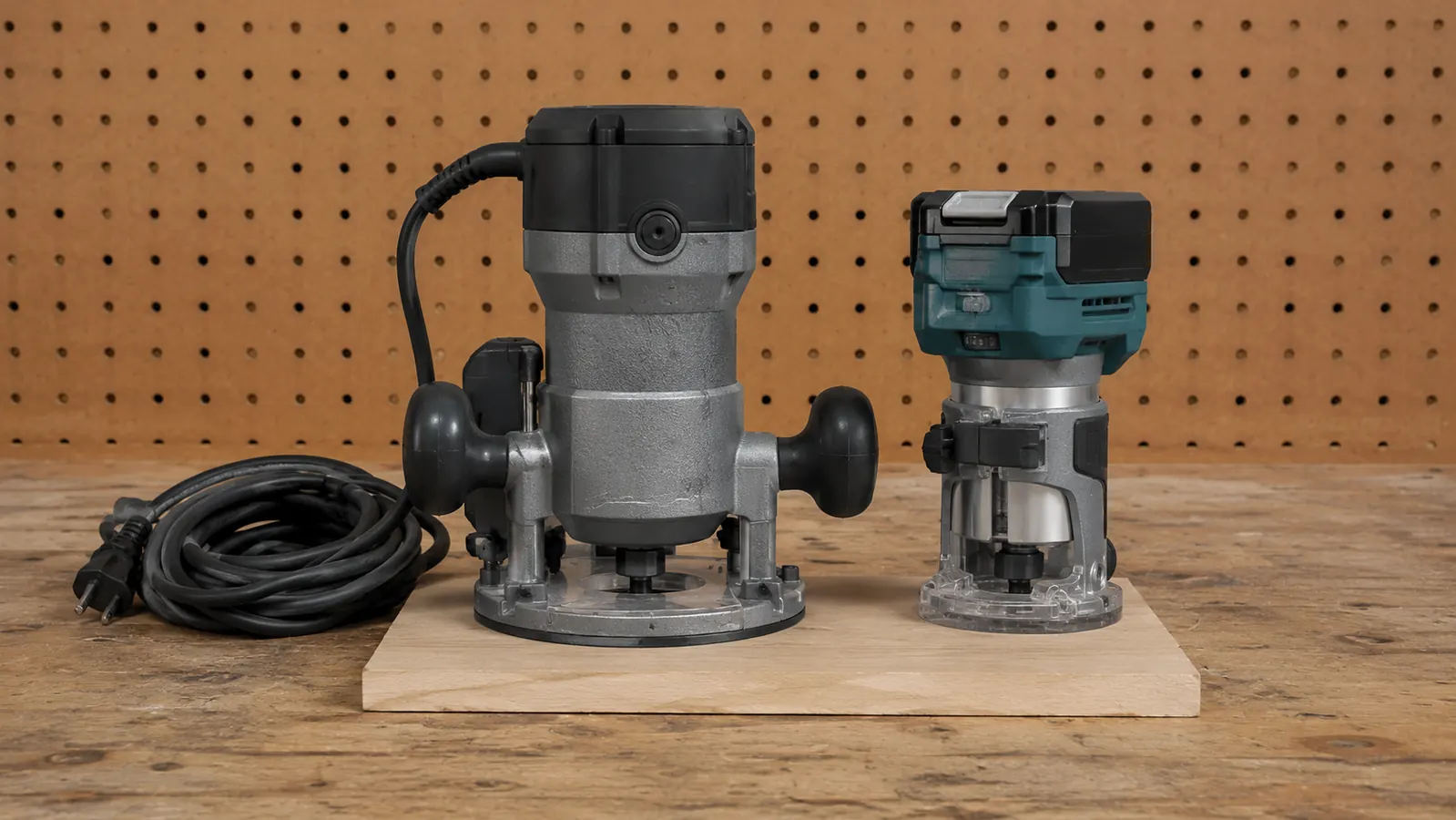
Here is the short answer. The Bosch Colt is a corded palm router with a 1-hp motor, a 5.6-amp draw at 120 volts, variable speed from 16,000 to 35,000 rpm, and an aluminum fixed base with both macro and micro depth adjustment. A cordless compact router gives up the constant power and the top of that speed range in exchange for no cord to drag, no outlet to hunt for, and the ability to work where a cord will not reach. In a two-car garage with a 20-amp circuit on the wall, the Colt is the smarter tool most days of the week. On a ladder, in a driveway, or kneeling in front of a built-in that is already fastened to the wall, the cordless router wins and it is not close.
| Bosch Colt PR20EVS | Cordless compact router | |
|---|---|---|
| Power source | Corded, 120 volts, 5.6 amps, constant | One battery pack, no cord to manage |
| Speed range | 16,000 to 35,000 rpm with a variable speed dial | Holds its speed well, but tops out lower |
| Depth adjustment | Separate macro and micro stages on the fixed base | One stage, so you set it and check it |
| Bit capacity | Fixed base accepts bits up to 1-5/16 in. | Varies by model and by collet size |
| Weight in hand | 3.3 pounds as listed | Bare tool plus a battery pack in the base |
| Working away from an outlet | Needs a live circuit within cord reach | Works anywhere the pack fits |
| Cord over a finished face | The cord drags unless you manage it every pass | Nothing to snag, nothing to drag |
| Installed trim and overhead work | The cord pulls at the wrong moment | One hand free, no tether |
| Runtime | Runs as long as the circuit holds | Stops for a pack swap |
| Footprint on the shelf | 3.75 in. wide, 7.5 in. tall | Taller once a pack is seated |
| Best for | Bench work, repeatable passes, hardwood | Trim already on the wall, ladder work, no power on site |
Where the Bosch Colt Wins
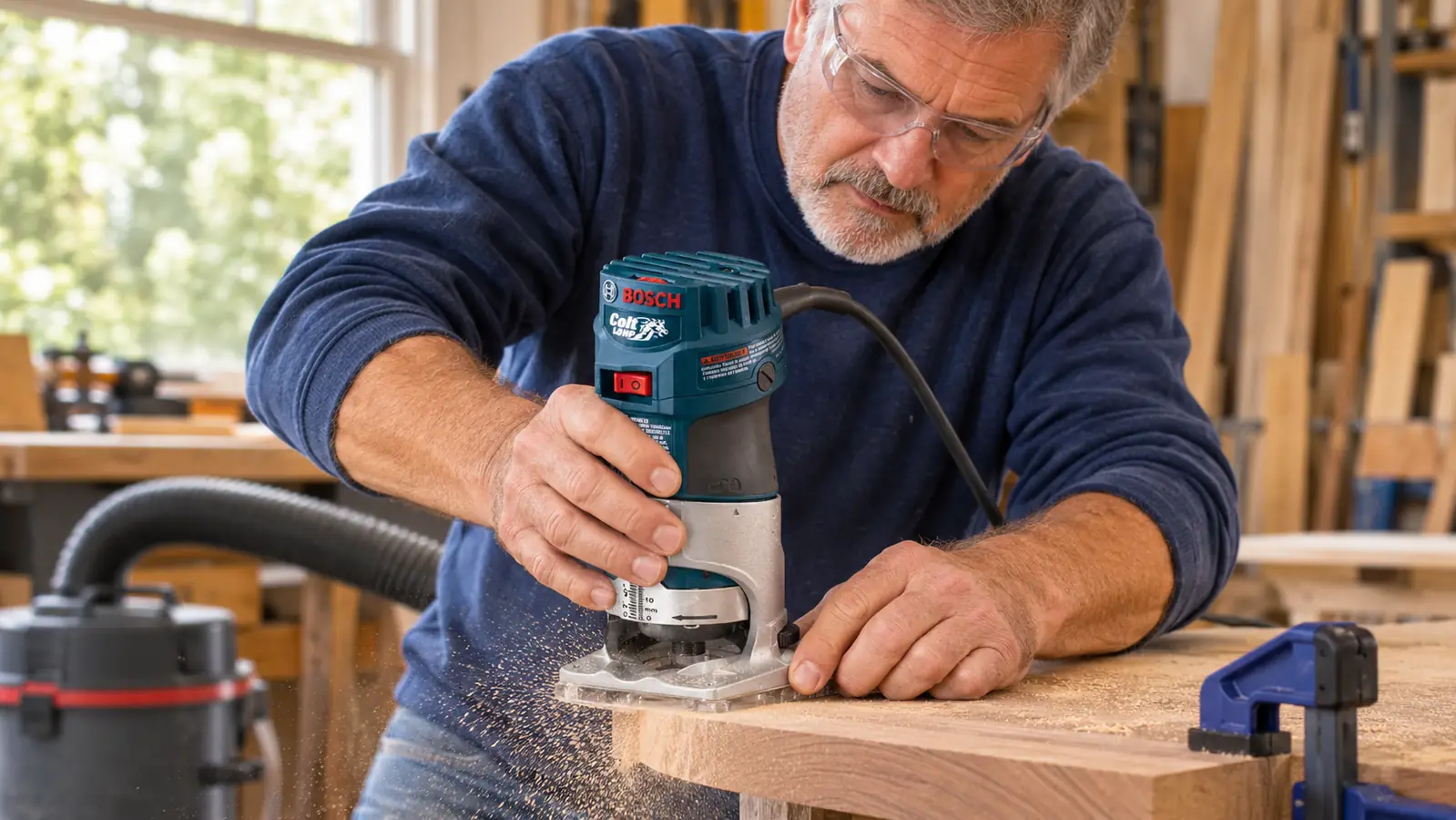
The first thing you notice on a real cut is that the speed does not sag. The Colt carries a 1-hp motor drawing 5.6 amps at 120 volts, and it holds 16,000 to 35,000 rpm under load in a way that a pack-fed tool simply cannot promise. Put a roundover bit in hard maple and push it into the corner of a board and you can hear the difference immediately. The corded router stays on pitch. The cordless one drops a note and lets you feel it through the base. Soft-start circuitry also takes the jump out of the switch, so the tool does not torque in your hands when you flip it on, which matters more when you are balancing a small base on a narrow edge.
Last March I ran a 1/4-inch roundover down 14 feet of red oak shelf edging for a built-in bookcase in Carol's sewing room. Forty-some passes, counting the short returns at each end. I had a cordless compact router on loan that week and I tried it first, because the cord was already tangled around the shop vac cart. It cut fine for the first six feet. By the eighth foot, working through a knot, it slowed enough that I stopped the pass and checked the bit, thinking it had slipped in the collet. The bit was fine. The tool was simply asking for a break I did not want to take. I finished the run on the Colt and the pitch never moved.
Depth adjustment is the quieter reason I keep reaching for it. The fixed base on the Colt has separate macro and micro stages. You release the lock, drop the motor to roughly where you want it, snug it, then use the micro adjustment to walk the bit down in fine increments. That is how I cut a juice groove in a cutting board and how I fit an inlay into the lid of the cedar chest I built for my daughter. The whole job is four or five passes at increasing depth, and each pass has to match the last one exactly. A single-stage depth ring can do that work, but you spend more time checking and less time cutting.
It is also a small, light tool. Listed at 3.3 pounds, 3.75 inches wide and 7.5 inches tall, with the finger support pockets molded into the base for extra stability when you are trimming edges. That last detail sounds like marketing and is not. When you are running a chamfer along a shelf, your fingertips sit in those pockets and the tool stops wanting to tip. The fixed base takes bits up to 1-5/16 inches, which covers every bit I own, and the 1/4-inch self-releasing collet chuck lets go of the bit without a fight.
Where the Cordless Router Wins
The cord is not a small annoyance. On a long run of edge profile, that cord has to go somewhere, and the somewhere it chooses is usually across the face you just finished. I have watched a cord drag a fresh chamfer across a coat of oil and leave a mark I had to sand out. You learn to loop it over your forearm or clip it to your belt, and then you are working one-handed on a tool that wants two. A cordless compact router removes that entire category of problem. There is nothing to route around, nothing to snag on the corner of the bench, and nothing to trip over when you step back to look at the cut.
The worst version of this happened on a set of Adirondack chairs two summers ago. I had them assembled and upside down on sawhorses in the driveway, wanting a small chamfer on the top edge of each arm. The extension cord reached, barely, and every time I walked around a chair it came taut and pulled the plug out of the strip. Four chairs, eight arms, and I re-plugged that cord more times than I made cuts. A cordless router would have finished the job before I got the strip untangled.
Then there is the outlet question. My shop has a 20-amp circuit I ran myself and a shop vac on a cart, so power is never far away. That is not true in the rest of the world. The cordless router goes out to the truck bed when I am fitting a piece of trim to a friend's porch. It goes up a ladder to chamfer the edge of a built-in shelf that is already screwed to the wall. It goes into the driveway where the extension cord would have to cross a wet slab. Every one of those jobs is small, and small jobs are exactly where setup time decides whether you bother.
I will be fair about the power gap, because it is narrower than some people claim. On softwood, with a small roundover or a chamfer, one light pass, you will not notice much. The cordless router does that work cleanly. The difference shows up in hardwood, in deeper profiles, and in the third and fourth pass when the cutter is fully engaged. That is where the corded tool's constant rpm earns its place on the pegboard. If every cut you make is a shallow edge treatment on pine, the power argument mostly evaporates. If you cut box joints in oak, it does not.
The router that lives on the pegboard, not on a charger
Corded, 1 hp, 16,000 to 35,000 rpm, with macro and micro depth adjustment on an aluminum fixed base. It runs off the circuit you already have and it is ready the second you pick it up.
Amazon Check Today's Price on Amazon →3.3 pounds, a 3.75-inch-wide body, and 35,000 rpm on tap. That is the whole reason it stays on the pegboard.
Setup, Storage, and the Battery Question
There is a maintenance side to this that nobody mentions in the spec sheets. A corded router asks almost nothing of you. Blow the dust out of the vents, check the collet, and put it back on the pegboard. A cordless router brings a charger, at least two packs, and the ongoing business of keeping those packs alive. My garage is not heated, and a Virginia January is hard on lithium. Packs that live out there lose capacity faster than the ones I keep inside, and a pack that is cold and half charged is a pack that lets you down on the one cut you actually needed to make that afternoon.
Storage is a smaller factor but a real one. The Colt stands on a shelf in a footprint of roughly 3.75 by 7.5 inches, cord coiled and tied. A cordless compact router with a pack seated is taller, and the charger and spare packs take up more shelf than the tool does. In my shop the Colt hangs on a peg between the block plane and the marking gauges, and the reach-and-go is about four seconds. A cordless compact router with two packs and a charger wants a shelf roughly 14 inches wide, plus an outlet for the charger, which in a garage shop is an outlet you were using for something else. That reads as a petty complaint until you have spent ten minutes looking for a charger you set down on the truck tailgate in October.
In a two-car garage where one bay is the shop and the other is the truck, shelf space is not abstract. It is the difference between a tool you grab and a tool you have to dig out from behind the shop vac. The Colt also carries a limited one-year warranty, which is thin, and I would rather say so than pretend otherwise.
What I'd Tell a Beginner
If you are buying your first compact router and you work at a bench with power nearby, buy the corded one. You get more speed range, finer depth control, and one less system to feed. Learn feed direction on scrap pine before you touch a real board. Right to left along a straight edge when the cutter is buried in the material, and pay attention to which way the bit is pulling. Most tear-out I see on a beginner's project is not the tool's fault. It is feeding the wrong way, or taking one deep pass where four light ones would have come out clean.
The first chamfer I ever cut, back around 2001, I fed a board the wrong way across an edge and the bit grabbed it and threw it against the garage door. I still have that board leaning in the rafters. It is a reminder that the router is the least forgiving tool on the bench, and that light passes and the right feed direction cover for a lot of inexperience.
Buy one good bit before you buy six cheap ones. A sharp spiral or a decent roundover in a 1/4-inch shank will teach you more about what the tool can do than a box of assorted cutters that dull after two boards. And resist the urge to run the speed dial wide open for everything. Small bits in hardwood want the higher end. Larger bits and any cut where the bit is fully buried want a slower speed. That variable speed dial is not decoration, and the difference in finish quality between 16,000 and 35,000 rpm on the wrong bit is obvious the moment you lift the router.
Who Should Buy Which
Buy the Bosch Colt if your work happens at a bench. Cutting boards, small boxes, shelf edges, chamfers on an Adirondack chair arm, a groove for a cabinet back. That is my work, and it is the work most weekend woodworkers do. You want the full speed range, you want to dial a depth in two stages and trust it, and you want to pick the tool up a year from now without wondering whether the pack still holds a charge. The one-year warranty is the weakest part of the deal, and the cord is the second weakest, and neither has cost me a project yet.
Buy a cordless compact router if the work follows you around. Trim in a house with the power shut off at that end. A shelf edge on a built-in that is already attached. A chamfer on a picnic table out in the yard where the nearest outlet is behind a locked door. Or if you already run that brand's batteries and chargers, because then the tool itself costs you very little and the packs are already on the shelf. Plenty of shops end up with both, and that is not indulgence. It is recognizing that one tool does the bench and the other does everything the bench cannot reach.
For the bench work, this is the one I keep plugged in
1 hp, 5.6 amps, 16,000 to 35,000 rpm, aluminum fixed base with macro and micro depth adjustment, and a 1/4-inch self-releasing collet. Bits up to 1-5/16 inches fit the base.
Amazon Check Today's Price on Amazon →