

For the first fifteen years I owned chisels, I owned bad ones. They came in a blister pack from a hardware store that has since closed, and I sharpened them so often that the 12 mm wore down toward a 10 mm. I built a cedar chest and two sets of bookshelves with those chisels, and every joint in them needed filler. I assumed that was simply how woodworking went for a weekend guy in a garage.
Then I bought the Narex 6 piece set, the one that comes in the wooden presentation box, and my joints changed before my technique did. That is the part nobody explains. Better steel does not turn you into a better woodworker overnight, but it does stop punishing you for being an average one. The Narex blades are chrome-manganese steel tempered to Rc 59 and ground to a 25 degree bevel, and the set runs 6, 10, 12, 16, 20 and 26 mm. Here is what twenty five years of weekend work has taught me about why that matters, reason by reason.
Six widths from 6 mm to 26 mm, ground at 25 degrees and boxed
The Narex 6 piece set covers every joint I cut at my bench: chrome-manganese blades at Rc 59, stained European beech handles, and a wooden box that keeps the edges apart between projects. It is the tool purchase I would make again first.
Amazon Check Today's Price on Amazon →A 25 degree bevel cuts end grain instead of bruising it
Every chisel leaves the factory with an angle, and that angle decides what the tool wants to do. At 25 degrees the Narex edge is thin enough to slice pine end grain clean and steep enough to survive white oak without folding over. My old chisels were sharper than they had any right to be after an hour on the stones, and they still crushed the far side of a board because the geometry was wrong. You cannot sharpen your way out of the wrong bevel angle. You can only grind past it.
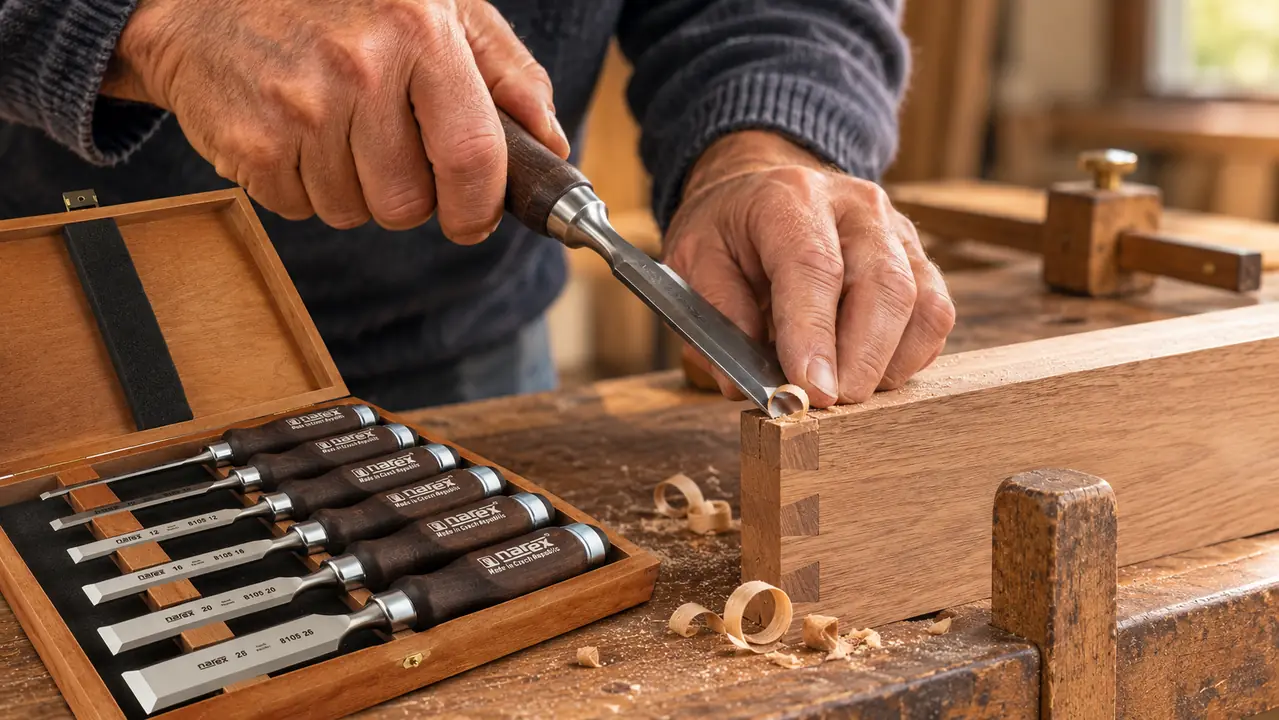
Six widths from 6 mm to 26 mm cover the joints I actually cut
A chisel set is only useful if the sizes match the work in front of you. The 6, 10, 12, 16, 20 and 26 mm spread here covers dovetails, mortises, hinge pockets and the shallow rabbets behind a cabinet back. The 12 mm does most of the general work, the 20 and 26 mm clear waste quickly, and the 6 mm gets into places where nothing else fits. When I owned three chisels, I spent half my time making one do a job it was too wide for.
Rc 59 steel holds an edge through a whole cutting board
Hardness is the number that decides how often you walk back to the stones. Rc 59 is a working hardness: hard enough to hold through a cutting board session, not so hard that the edge chips the first time you catch a knot. These blades are chrome-manganese steel, tempered, and they take a fine wire edge off the stone in a way softer chisels never quite manage. I sharpen once at the start of a project now. I used to sharpen in the middle of one.
Sharpening takes ten minutes, not an evening
The back of a chisel is half the edge, and if it is not flat you will chase the burr past midnight. These blades came flat enough that a coarse stone and a few minutes had them reading clean across the full width. After that it is a routine: hone the bevel, kiss the back, strop, go back to work. My old set needed an hour of work before it cut anything worth looking at, and I never got one of them truly flat.
Bevel edges reach a dovetail corner without gouging the sides
A bevel edge chisel tapers along its sides so the blade can reach into a corner and still leave the walls alone. That shape is the whole reason a hand cut dovetail looks hand cut instead of chewed. When I pare the baseline on a set of pins, the bevel edge lets me tilt the chisel and work into the corner without the flank of the blade bruising the tail beside it. A square edge chisel cannot do this. It can only get close and then stop.
I sharpen once at the start of a project now. I used to sharpen in the middle of one.
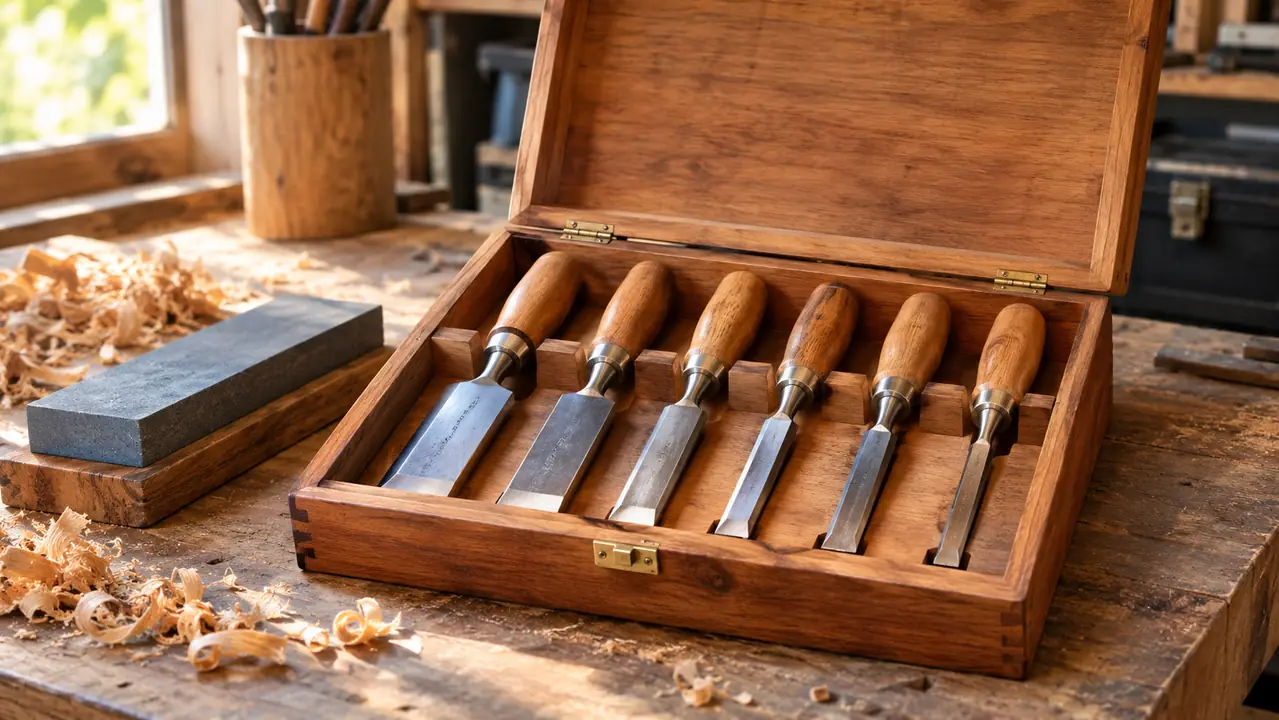
Stained European beech handles that do not blister your palm
Wood handles get a bad name because cheap ones are slick and varnished. These are stained European beech, and the shape sits in the hand without forcing your grip into one position. I chop mortises with a mallet and pare with my palm, and after a long session the handle has not raised a hot spot. It also stays put when the humidity in the garage climbs, which around Richmond it does from June through September.
The wooden box keeps the edges from meeting each other
A drawer full of loose chisels is a drawer full of dull chisels. The Narex set arrives in a wooden presentation box with a fitted slot for each size, so the blades never knock against one another between projects. I keep the box on a shelf under the bench and pull the whole thing out when a job starts. It is not a piece of furniture, but it has survived several years of being opened, closed, and once dropped on the concrete.
1.6 pounds for the whole set, so it goes where the work is
The entire set weighs 1.6 pounds and the box measures about 6.37 inches by 13.5 inches. That is small enough to sit on the bench beside the project instead of behind you on a shelf, which sounds minor until you count how many times you turn around in an afternoon. Light tools get used. Heavy boxes get left where they sit, and you make the wrong chisel do the job because reaching for the right one is a chore.
The 6 mm and 10 mm pay for themselves on boxes and boards
Small work is where a bad chisel shows up worst. Cleaning waste out of a narrow groove in a box side, or paring the end of a cutting board handle down to a pencil line, needs a slim blade that holds an edge at a fine angle. The two smallest sizes in this set get more use at my bench than the big ones. One clean paring pass across the end grain saves a half hour of sanding that never quite gets the corner right anyway.
These are the chisels still in the drawer in year ten
I have bought tools that were fine on day one and useless by year three. Steel softens with poor heat treating, handles work loose, and a set that felt solid in the store starts to rattle. Nothing on this set has loosened. The blades hold the edge they did when I took them out of the box and the handles are still tight to the steel. When I think about what I would replace first, it is not the power tools.
What I'd Skip
If you are choosing between this set and a larger one, know what you give up. The run stops at 26 mm, so a wide dado or a deep mortise in a bench leg still wants a bigger chisel or a router. There is nothing narrower than 6 mm, which matters if you are cutting small hinge pockets in a jewelry box. And the wooden box, useful as it is, takes up a strip of bench you may not have in a garage shop with one bay.
The other thing I would skip is the idea that you need a full sharpening station before you start. A combination stone and a strop will get these working. Buying a jig, three diamond plates and a granite reference surface before you have cut your first dovetail is a way to spend money instead of making a joint. Learn the bevel on one chisel, get it right, then do the rest of them.
The chisel set I would buy again before any power tool in the shop
Six widths, chrome-manganese blades at Rc 59, stained European beech handles, and a wooden box that keeps the edges apart. If your joints are fighting you, the chisel is the cheapest part of the problem to fix.
Amazon Check Today's Price on Amazon →