
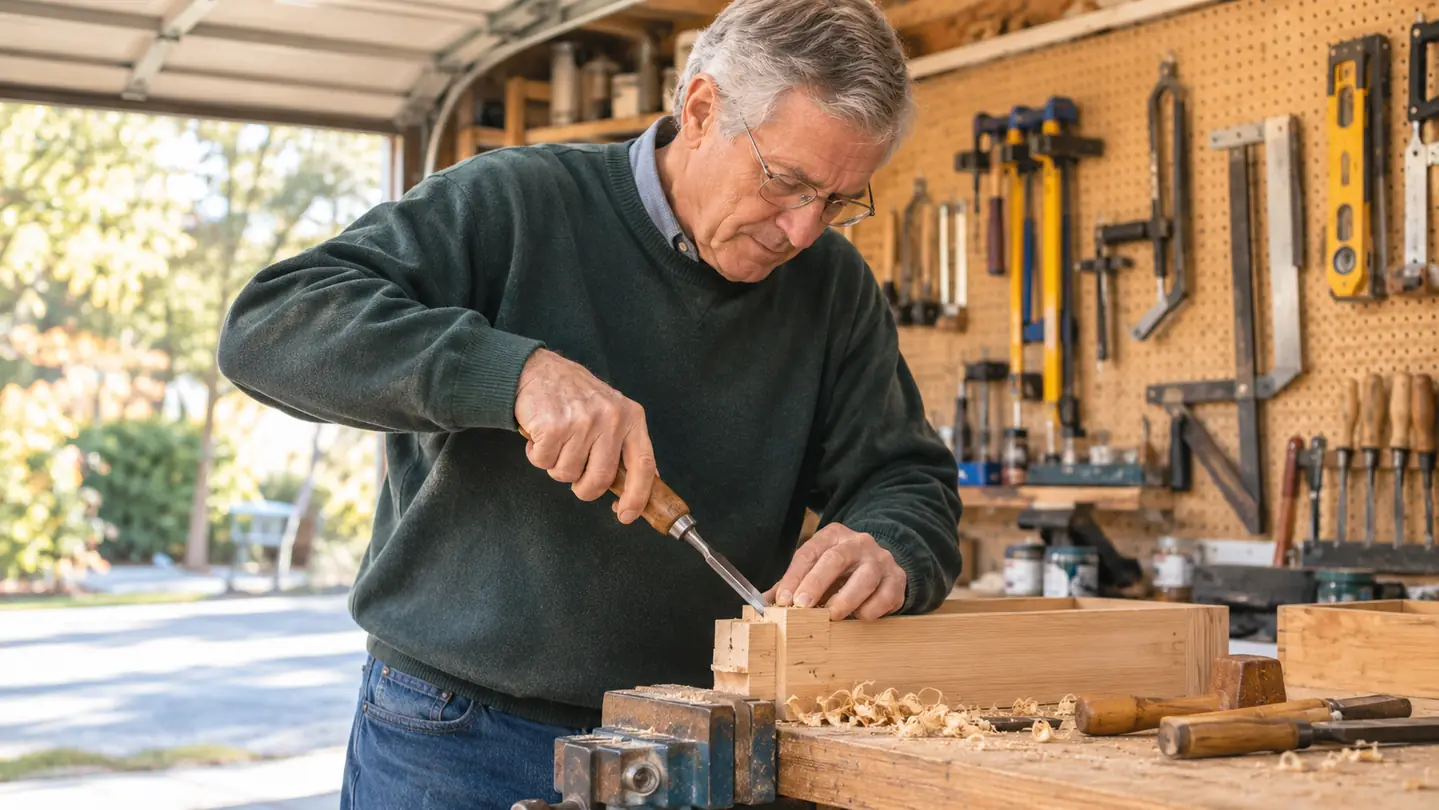
Short answer: a budget chisel set will cut wood. The Narex 6 pc set will cut wood and keep doing it after you have flattened the back, honed the edge, and used it on a few hundred joints. I keep a Buck Bros. six-piece set in the bottom drawer for opening paint cans and scraping glue. The Narex set lives on the bench, within arm's reach of the vise. That is the difference in one sentence.
I am Gene Halvorsen. I am 63, a retired commercial electrician, and I work out of a two-car garage outside Richmond, Virginia. One bay is the shop. The other bay holds the truck. I have about 25 years of weekend woodworking behind me, mostly bookshelves, a cedar chest, cutting boards, a picnic table, and the workbench I built first. I do not run a cabinet business. I make furniture for the family and I try not to waste lumber. When I say a tool is worth the extra money, I mean it survives my mistakes and still takes an edge.
| Narex 6 pc Set | Budget Set | |
|---|---|---|
| Sizes in the set | 6, 10, 12, 16, 20 and 26 mm (1/4, 3/8, 1/2, 5/8, 13/16 and 1-1/16 in) | Usually four to six common sizes, with gaps at the narrow and wide ends |
| Blade steel | Chrome-manganese steel, hardened to Rc 59 | Steel grade is often not stated on the package |
| Edge as delivered | Bevel ground at 25 degrees; still needs honing for your work | Often needs a full reset on coarse stones |
| Handles | Stained European Beech | Hardwood or plastic, fit and finish varies by set |
| Storage | Wooden presentation box | Plastic tray or no box |
| Set weight | 1.6 pounds | Usually lighter, which is not always a plus |
| Up-front outlay | More than a house-brand set | Less |
| Rough work and loaning | I do not lend these | Good for scraping glue, opening cans, and loaning to a neighbor |
| Time to make it work | Honing only, in most cases | Flattening and regrinding often needed |
| Best for | Furniture joints, paring, and daily bench work | Rough carpentry, paint cans, and trying hand tools without commitment |
What the Extra Money Actually Buys
The first thing the extra money buys is a known steel. The Narex blades are chrome-manganese steel, hardened to Rc 59. That number is not a promise of perfection. It is a hardness that holds a working edge without becoming brittle in normal bench use. A budget set may use decent steel, but the package often does not tell you what it is. When you sharpen a chisel you are shaping the steel. If you do not know what you are shaping, you guess.
The second thing is the grind. The Narex set comes with a 25 degree bevel. That is a starting point for paring and chopping, not a finished edge. I still take mine to a 1000 grit stone and then a finer stone before I use it on a joint. The difference is that I am honing a bevel that is already even. On the budget sets I have handled, the bevel often looks like it was ground on a belt sander after lunch. You can fix it. You will spend an evening doing it.
The third thing is the handles. The Narex handles are stained European Beech. They are held in the hand, not just looked at. A handle that is too fat or too slick makes a chisel feel like a screwdriver. The beech handles on the Narex set are shaped for control when you pare with the bevel down. I have not had one loosen. I cannot say the same for the handles on the budget set I keep in the drawer.
The fourth thing is the back of the blade, which is the part nobody talks about and the part that decides whether the chisel cuts true. A chisel only cuts as flat as its back. On a good blade the back is machined close enough that twenty minutes on a 1000 grit stone, working the edges first, gets you there. I did the 12 mm that way on a Saturday morning in March, coffee on the bench beside me, and by the time the coffee went cold I had a back I could trust against a straightedge. The budget chisel in the drawer took me two evenings and I never did get the last inch near the handle. It still rocks on the stone. I use it for glue.
Where Narex Wins
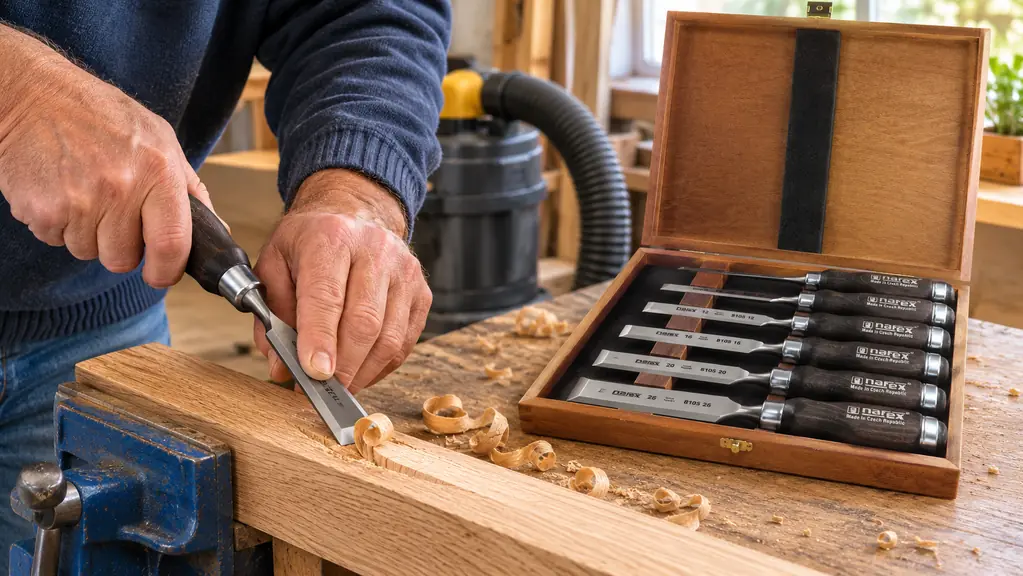
Narex wins on the range of sizes. The set covers 6, 10, 12, 16, 20 and 26 mm. In inches that is 1/4, 3/8, 1/2, 5/8, 13/16 and 1-1/16. That is not a random pile. The narrow sizes clean out pins and dovetails. The 12 mm is the one I reach for most on 3/4 stock. The 26 mm chops waste fast when I am not worried about a finish cut. A budget set often gives you four sizes and leaves you to buy the rest one at a time.
Narex also wins on edge holding. Rc 59 is hard enough that I can pare end grain on oak and not stop every five minutes. I still hone. I hone because I want the chisel to cut where I aim it. But I am not fighting a burr that rolls over on the first pass. The 25 degree bevel is easy to maintain on a stone. The wooden box is not a display piece in my shop. It keeps the edges from knocking against each other in the drawer. That matters more than it sounds.
I built a white oak chest last winter, about 36 inches wide, with through dovetails at all four corners. White oak is not a forgiving wood. It is hard, it is abrasive, and it dulls an edge faster than walnut or cherry ever will. I chopped the pins with the 16 mm and cleaned the corners with the 6 mm, and I went to the stone twice in the whole run: once after the first corner and once before the last. With the budget set I would have been back at the stone every corner. That is four trips across the shop per corner, and every trip is a chance to roll an edge you meant to keep crisp.
Where the Budget Set Wins
The budget set wins on up-front outlay. That is the honest answer. If you are not sure you will stay with hand tools, a house-brand set lets you find out without tying up much money. I have a set like that. I use it for scraping glue off a glue-up, opening a can of finish, and prying a lid off a bucket. I do not care if I nick the edge. That is a real job in a shop.
It also wins on loaning. I do not lend my Narex chisels. I lend the budget set. If a neighbor needs to trim a door or scrape a window sill, the house-brand chisel is the one that goes out the door. And it wins on learning to sharpen. You can make your beginner mistakes on a cheap chisel and not feel sick about it. I flattened the back of my first budget chisel on a concrete step because I did not know better. I would not do that to the Narex.
My first real set came from a hardware store that is no longer there, four chisels in a plastic tray. Nobody told me the backs needed flattening. I clamped the 1/2 inch in the vise, grabbed a coarse oil stone, and scrubbed at it for the better part of an hour without ever checking that the stone itself was flat. It was not. I put a hollow in the stone and a curve in the back of the chisel, and then I spent a second evening trying to undo the first one. That stone now lives under the bench and gets used for lawn mower blades. The mistake cost me two evenings and taught me more about sharpening than any video I have watched since. Make that mistake on a cheap set.
A sharp budget chisel will outcut a dull premium chisel. But a sharp premium chisel will stay sharp through the joint, and that is what you are paying for.
The set I reach for when a joint has to close
The Narex 6 pc set is not the cheapest way to own a chisel. It is the set I keep on the bench because the sizes, the steel, and the handles let me work without stopping to fight the tool.
Amazon See the Narex Set on Amazon →Who Should Buy Which
Buy the Narex set if you are going to cut joinery. If you are building bookshelves, a chest, a workbench, or small boxes, you will use the 6, 10, 12 and 16 mm chisels constantly. You will appreciate the 20 and 26 mm when you chop waste. You will appreciate the beech handles when you pare for an hour. And you will appreciate the box when you open the drawer and the edges are still where you left them.
Buy the budget set if you are not sure yet. Or buy it as a second set for rough work. I would not try to build a dovetailed drawer with a set that needs a full regrind and has handles that roll in your hand. But I would happily use one to scrape paint. The mistake is buying the cheap set and expecting it to behave like the Narex after ten minutes of honing. It will not. The steel is not the same and the grind is not the same.
What I'd Tell a Beginner
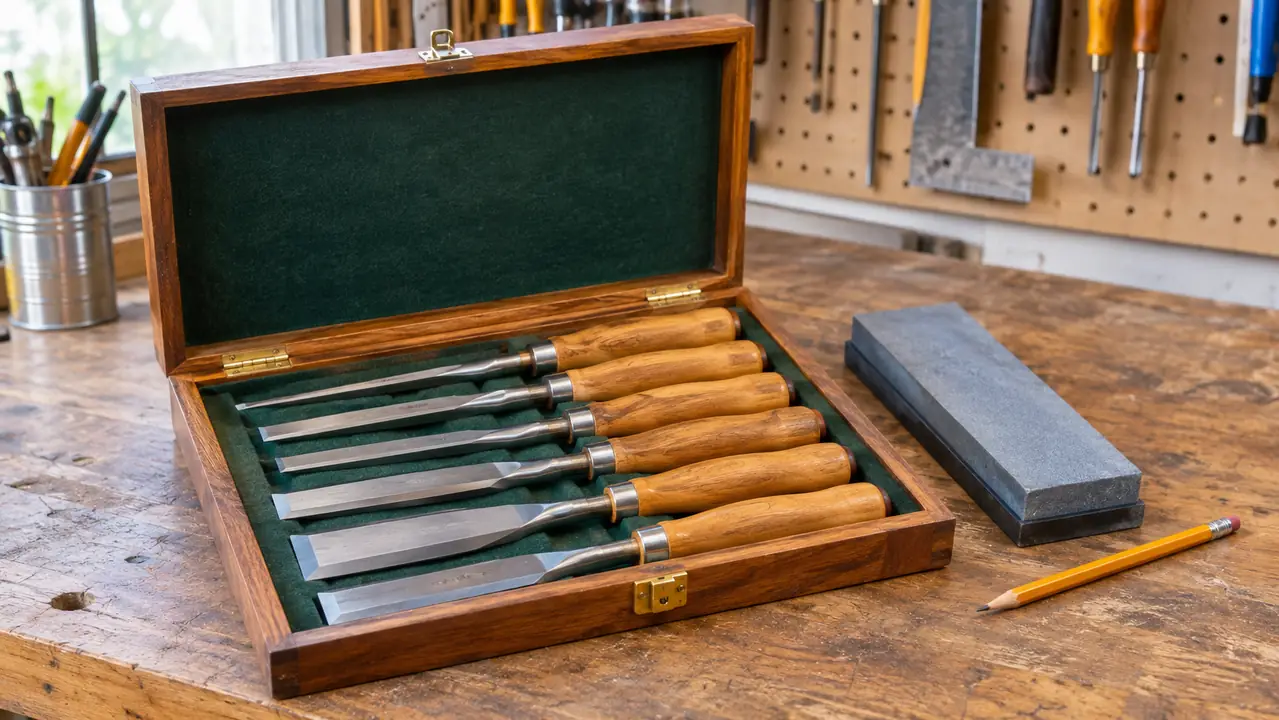
Learn to sharpen before you buy the good set. A sharp chisel from a budget set will outcut a dull chisel from a good set every time. Get a stone, a flat plate, and a strop. Learn to feel the bevel sitting flat. Learn what a wire edge feels like when you pull it off. Once you can get a chisel sharp, you will know what the extra money buys because you will feel the difference in how long the edge lasts.
Then buy the sizes you actually use. The Narex set gives you six sizes in one box. That is convenient. But if you only build picnic tables and Adirondack chairs, you may not need a 6 mm chisel. If you build small boxes, you will use it more than you think. I use the 6 mm to clean out the corners of a half-blind dovetail. I use the 26 mm to chop the waste. The middle sizes do the daily work.
The Sharpening Question
The Narex set comes with a 25 degree bevel. I keep my bench chisels at 25 degrees for general work. If I am paring softwood, I might add a tiny micro bevel. If I am chopping oak, I do not go lower. A lower angle cuts easier but the edge will not last as long. A higher angle lasts longer but feels dull. The 25 degree bevel is a sensible place to start. You can change it later if your work asks for it.
The budget sets I have owned came with bevels that were not consistent from one chisel to the next. One was nearly 30 degrees. One was closer to 20. That means you cannot set your honing guide once and do the whole set. You have to reset for each chisel. That is not the end of the world. It is just time. And time is the thing you are trying to buy with the Narex set.
My sharpening station is a granite floor tile I got for nothing from a countertop shop, with wet and dry paper stuck to it, sitting on a scrap of plywood on the end of the bench. Coarse paper to flatten, 1000 grit to hone, then a leather strop loaded with green compound. From dull to shaving takes me about four minutes on a chisel whose back I have already flattened. That number matters more than it sounds, because it decides whether you touch up the edge before a cut or push through with a dull tool. A set that needs a regrind every time pushes you toward the second choice, and the second choice is how tear-out happens.
The Box and the Sizes
The Narex set comes in a wooden presentation box. I did not think I would care. I care now. A chisel roll is fine, but the box keeps the chisels separated. The 1.6 pound set is easy to carry from the bench to the sharpening station. The box is 6.37 inches long and 13.5 inches wide, so it fits on a shelf above the bench. That is not a small thing in a garage shop where every surface has to earn its place.
The sizes are marked in metric and inch on the product listing. The set is 6, 10, 12, 16, 20 and 26 mm. The inch equivalents are 1/4, 3/8, 1/2, 5/8, 13/16 and 1-1/16. I work in inches for most furniture, but I use the metric sizes because they are what I have. After a week you stop converting. You reach for the chisel that fits the gap.
If you are ready to stop fighting the tool, start here
The Narex 6 pc set is the set I would buy again for a garage shop. Six sizes, chrome-manganese steel at Rc 59, beech handles, and a box that keeps the edges apart. It is not cheap. It is the one I keep on the bench.
Amazon See the Narex Set on Amazon →