

I bought the Narex 6-piece chisel set because my old chisels were doing more damage than good. The 1 inch hardware store chisel I had used for years had a back like a potato chip, and every time I pared a mortise I spent more time fixing tear-out than cutting joinery. I wanted a set that would let me work to a pencil line, not one that made me reach for sandpaper. The Narex set has been on my bench for about seven months now, through cutting boards, a white oak side table, a set of built-in shelves, and more small boxes than I care to count. This is what I found.
I am not a professional cabinetmaker. I am a retired electrician who has been building furniture in a two-car garage for about 25 years, and I care about whether a tool helps me cut a clean joint without adding an hour of setup. The short version: the Narex set is the first set of chisels I have owned where I reach for the tool instead of the sandpaper. It is not perfect, and I will get to the parts I do not like. But for the work I do, it has changed how I think about chisels.
The Quick Verdict
A useful six-size set with steel that holds a good edge, held back only by edges that need honing and a box that belongs on a shelf, not on a job site.
Amazon Check Today's Price →Six sizes that cover the joinery most garage shops actually cut
The 12 mm and 16 mm do the daily work. The 26 mm flattens a wide dado. Check the current price and the full size list on Amazon.
Amazon Check Today's Price on Amazon →How I've Used It
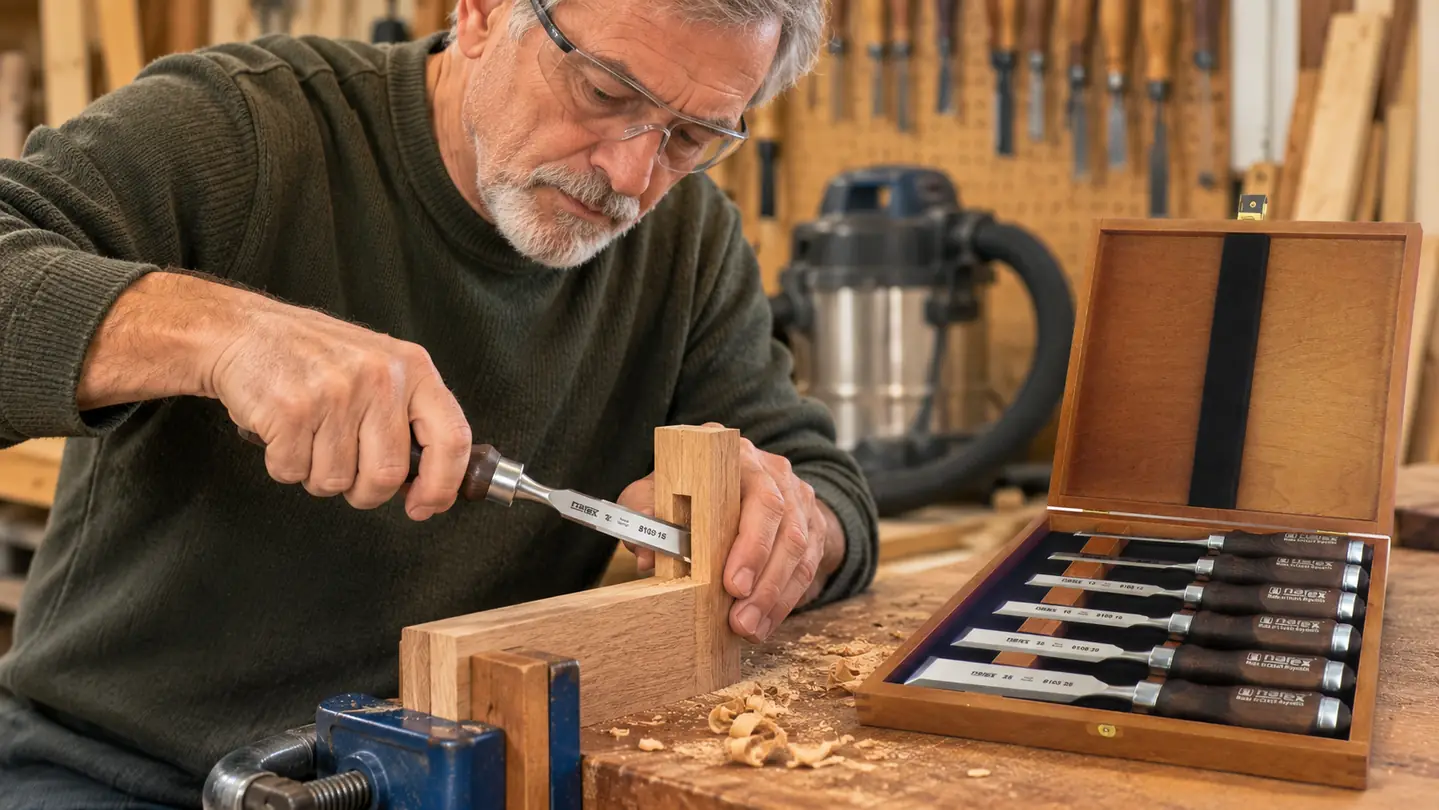
The set lives in the wooden presentation box on a shelf under my bench. The box is fine for storage, but it is not a tool roll, and it takes up more bench space than a canvas roll when I have it open. Most of the time I pull out the 12 mm and the 16 mm and leave the rest in the box. Those two sizes handle the bulk of what I do: cleaning up mortises for a white oak side table, paring the ends of through-tenons on a small box, and trimming the corners of a cutting board before I run it through the router.
The 26 mm chisel is the one I did not expect to use much. It has become the tool I grab for flattening the bottom of a wide dado and for cleaning up the long grain on the edge of a shelf. The 6 mm chisel is the opposite. It is useful for getting into the corners of a small box, but it is delicate enough that I do not use it for chopping. I use it for paring, and I keep it sharp. The 10 mm and 20 mm fall in between, and they get used when the 12 mm or the 16 mm is the wrong width for the cut.
The first thing I did was sharpen the set. Out of the box the bevel is ground at 25 degrees, and the edges were sharp enough to cut, but not sharp enough for fine paring. I spent an evening on a diamond plate and a water stone, working through 1000 and then 6000 grit, and I flattened the back of each chisel until it registered flat across the edge. That took longer on the 6 mm and the 10 mm than on the wider sizes. After that, the edges held up well. I have touched them up on a strop maybe every other shop session, and I have not had to go back to the coarse stone.
What the Six Sizes Actually Cover
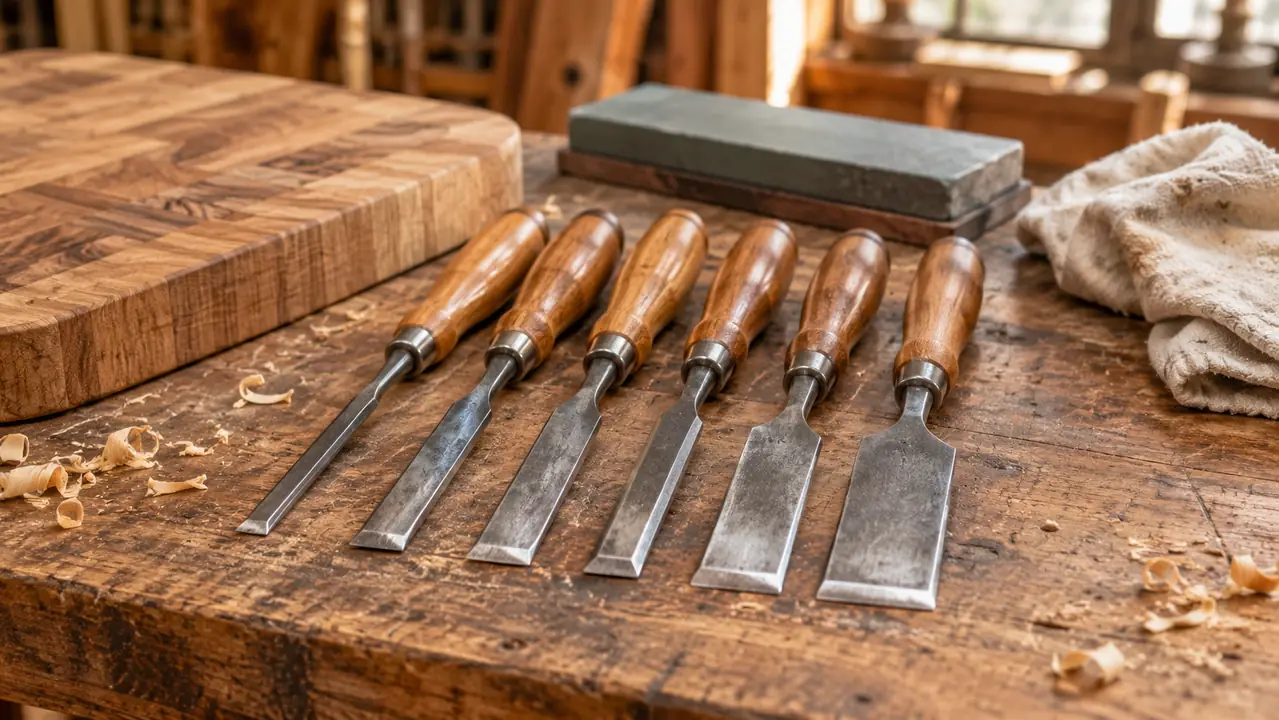
The set gives you 6, 10, 12, 16, 20, and 26 mm. In inches that is roughly 1/4, 3/8, 1/2, 5/8, 13/16, and 1-1/16. That is a useful spread for furniture work. The 12 mm and 16 mm are the everyday chisels. The 20 mm is good for wider mortises and for cleaning up the shoulders of a tenon. The 26 mm is a wide paring chisel, not a heavy chopping tool. The 6 mm and 10 mm are for small details, hinge mortises, and cleaning out the corners of a box.
The gap between 16 mm and 20 mm is small enough that I do not notice it in use. The gap between 20 mm and 26 mm is more noticeable. If I am chopping a wide mortise, I sometimes wish I had an 18 mm or a 22 mm, but that is a minor complaint. For most furniture projects, the six sizes cover what I need. I have not found myself reaching for a chisel that is not in the set, and I have not bought a single extra chisel since the set arrived.
The box has a cutout for each chisel, and the handles sit above the lid line. The box is made of wood and it has a sliding lid. It is a presentation box, not a job site box. If you plan to carry the set to a job, you will want a roll. If the set lives on a shelf in the shop, the box is fine. The set weighs 1.6 pounds, so it is not a burden to move around the bench. The box itself is about 13.5 inches wide and 6.37 inches deep, which tells you it was sized for the set, not for a tool bag.
The Steel, the Bevel, and the Back
The blades are chrome-manganese steel, hardened to Rc 59. That is not the hardest steel on the market, and it is not the softest. In use, it means the edge holds up to paring and light chopping, but it will not survive being used as a pry bar. I have hit a hidden staple in a piece of reclaimed pine, and the edge rolled slightly. I honed it out in a few minutes. If I had been using a harder steel, it might have chipped instead. I prefer a roll to a chip because it is easier to fix.
The bevel is ground at 25 degrees. That is a good angle for general bench work. I keep the primary bevel at 25 degrees and add a small micro-bevel at 30 degrees for chopping. For paring, I use the 25 degree bevel and strop it. The chisels are bevel edge, which means the sides are ground down to let you get into the bottom of a dovetail or a mortise. The bevel is not so thin that the edge feels fragile, but it is thin enough to get into tight corners. That matters when you are cleaning out the waste in a half-blind dovetail and the chisel has to sit flat on the side of the pin.
The backs are not perfectly flat out of the box. They are close, but I spent time on the 6 mm and the 10 mm to get them flat across the edge. That is normal for chisels in this range. If you are not willing to flatten the back, you will not get the best out of the set. Once the backs were flat, the chisels worked the way they should. The 16 mm chisel in particular became a reliable tool for paring end grain on a cutting board, and it left a surface that needed only a light sanding.
How They Hold Up in a Garage Shop
My shop is a converted two-car garage with a concrete floor and a shop vac on a cart. It is not climate controlled. In the summer it gets humid, and in the winter it gets cold. I wipe the chisels down with a rag and a little camellia oil after each session, and I have not seen any rust on the blades. The handles are stained European beech, and they have held up well. The finish is still intact, and the handles have not loosened. I have not had to tighten any of them.
I have dropped the 12 mm chisel once, onto the concrete floor. It landed on the corner of the handle and put a small dent in the wood. The blade was fine. The handle is still solid. That is about what I would expect from a beech handle. If you are the kind of person who drops tools regularly, you might want a handle with a metal hoop, but I have not had a problem. The dent is a reminder to keep the chisels on the bench, not on the edge of it.
The set has been in use for about seven months. In that time I have built two cutting boards, a white oak side table, a set of shelves for the garage, and a small box for my granddaughter. I have used the chisels on white oak, hard maple, walnut, and pine. The edges have held up well. I have not had to regrind any of them. I have touched them up on a strop and on a 6000 grit stone, and they are still cutting cleanly. The 26 mm chisel has done the most work on wide surfaces, and it has not shown any signs of the edge crumbling.
Where They Fall Short
The biggest issue is the box. It is a nice box, but it is not a working box. It takes up bench space, and the lid slides off and has to be set somewhere. I ended up making a simple rack for the chisels on the wall above the bench, and I keep the box on a shelf. If you want a set that comes in a roll, this is not it. The box is a presentation box, and it does that job well, but it is not a job site solution.
The 6 mm chisel is the weakest part of the set for me. It is useful, but it is small, and the handle is proportionally small. If you have large hands, it may feel cramped. I use it for light paring, not for chopping. The 26 mm chisel is wide and heavy. It is not a chisel I would want to use for a long period of paring, but it is good for flattening a wide surface. The edges need honing out of the box. That is not a defect, but it is worth knowing. If you do not have a sharpening setup, you will need to get one. The set is not a turnkey solution. It is a set of chisels that rewards a little setup time.
What I Liked
- Six useful sizes from 6 mm to 26 mm
- Chrome-manganese steel at Rc 59 holds an edge well
- 25 degree bevel is a good starting angle
- Stained European beech handles are comfortable and secure
- Wooden presentation box keeps the set together
- Backs flatten without excessive work
Where It Falls Short
- Edges need honing out of the box
- Box is for storage, not for carrying
- 6 mm handle may feel small for large hands
- No roll case included
- Wide 26 mm chisel is heavy for long paring
The 16 mm chisel took a 5/8 inch mortise down to the line in two passes, and the far side of the white oak came out clean.
Who This Is For
This set is for the hobby woodworker who builds furniture, boxes, and shelves in a garage shop and wants a set of chisels that will handle most of the work without buying individual chisels one at a time. It is for someone who is willing to flatten the backs and hone the edges, and who understands that a chisel is a cutting tool, not a pry bar. If you are building cutting boards, small boxes, or simple cabinets, this set will cover the sizes you need. It is also a good set for someone who has been using hardware store chisels and wants to see what a proper bench chisel feels like without jumping into the high-end range.
Who Should Skip It
Skip it if you are a site carpenter who uses a chisel for demolition or for prying. The steel will not hold up to that kind of abuse. Skip it if you want a set that comes in a canvas roll for job site carry. Skip it if you are not willing to sharpen. A dull chisel is dangerous, and this set will not stay sharp on its own. And skip it if you need a specific size that is not in the set. The six sizes are useful, but they are not every size. If you need a 3 mm chisel for tiny hinge mortises, you will have to buy it separately.
If your chisels are the tools you curse at, start with the sizes that do the most work
The 12 mm and 16 mm cover most bench joinery. The set comes in a wooden box and weighs 1.6 pounds. Check the current price and the full size list on Amazon.
Amazon Check Today's Price on Amazon →