

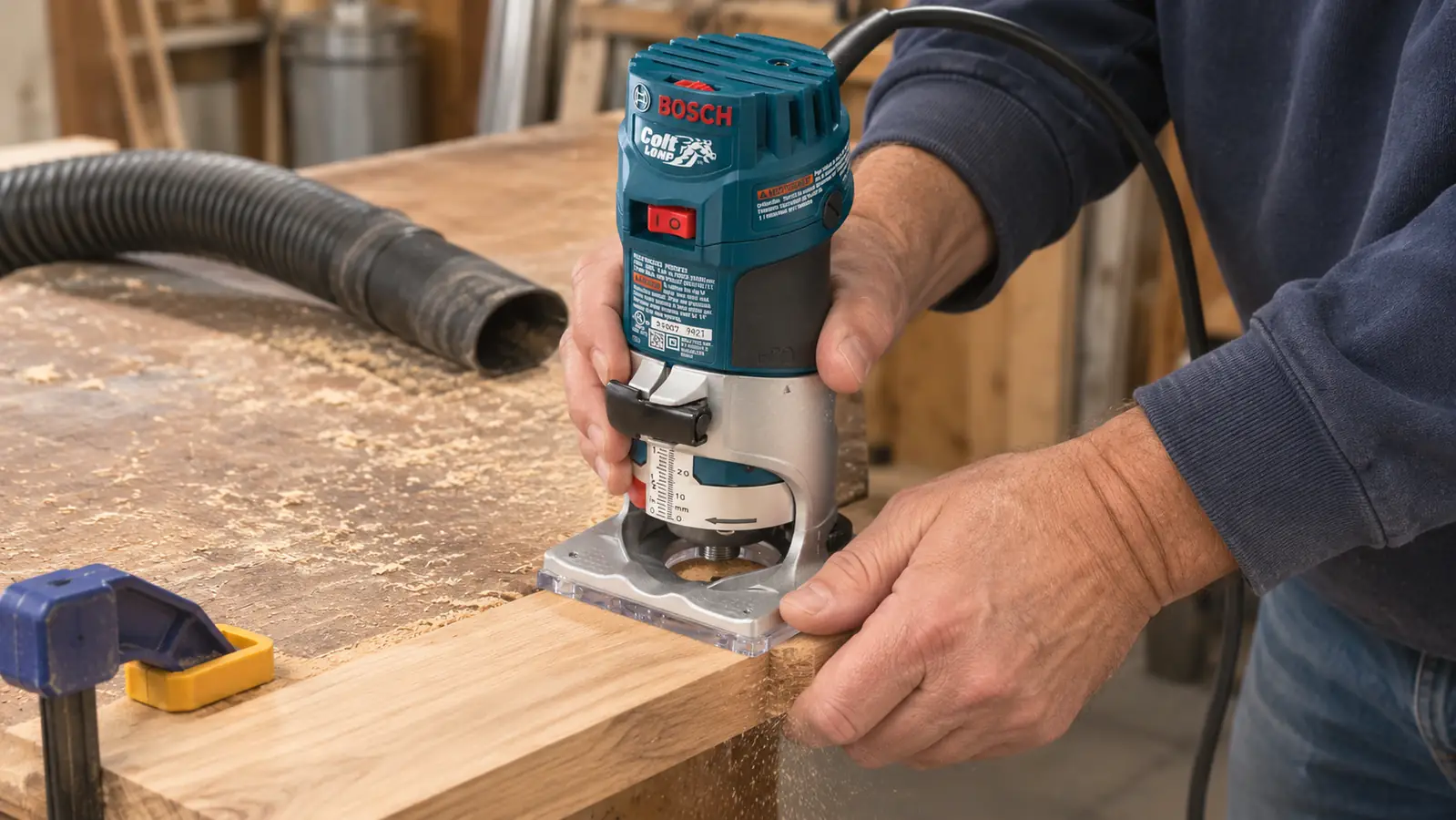
Two years ago I bought the Bosch Colt PR20EVS to do one job: put a roundover on the edges of a white oak cutting board that was too wide to handle safely on my router table. Every forum thread I read about small routers ended with somebody saying to just buy the Colt and be done with it. What none of those threads mentioned is what a palm router is genuinely bad at, and there is a real list. This is that list, along with the parts that turned out better than I expected, after a couple of years of weekend use in a one-bay garage shop outside Richmond, Virginia. I am not a cabinetmaker. I build shelves, cutting boards, small boxes and outdoor furniture, and I care about tear-out, square edges, dust, setup time and whether a tool is still running in year three.
The short version: it is a 3.3 pound, 1 HP, corded trim router with a fixed base and a 1/4 inch self-releasing collet, and it is very good at the jobs a small router should be good at. Edge profiles, hinge mortises, flush trimming, chamfers, shallow dados for shelf pins. It stops being wonderful wherever the work is wide, the cut is deep, or the bit wants more shank than a quarter inch can give. Bosch builds this one with the PR001 fixed base, and that base is the whole story of what the tool is and is not.
The Quick Verdict
Buy it for edges, mortises, flush trimming and anything small enough to hold in one hand. Do not buy it to replace a router table, and do not expect it to enjoy a buried cut in hard maple.
Amazon Check Today's Price →The router that comes off the pegboard nine jobs out of ten
1 HP, 5.6 amps, fixed base, 3.3 pounds. Soft start, macro and micro depth adjustment, and a self-releasing collet that lets go of the bit when you ask it to.
Amazon Check Today's Price on Amazon →What Nobody Tells You Before You Buy One
Start with the collet. The Colt takes 1/4 inch shank bits and nothing else. There is no 1/2 inch option and no adapter worth trusting. That matters more than the spec sheet suggests, because the bits that do heavy work in a shop, the big panel raisers, the long pattern bits, the cope and stick cutters, are mostly 1/2 inch shank for a reason. A quarter inch shank in a 1 HP trim router is a sensible pairing. A quarter inch shank asked to do the work of a half inch bit is how a board gets ruined, and possibly a hand.
Second, the base is fixed. Bit height is set before the cut with a macro knob, then trimmed in with a micro knob, and then you run the cut. There is no plunge, so anything that needs the bit dropped into the middle of a board, like a stopped groove or a hinge mortise set away from the edge, has to be worked in from the side or tipped in on a corner. People do it and it works. It is not the same as a plunge base, and if plunging is most of what you do, this is the wrong tool for the money.
Third, and this is the part I had to learn the hard way: 3.3 pounds is light, and light cuts in both directions. It is easy on the wrists when you are running a profile along a cabinet door held in a vise. It is also easy to tip. The body is tall for a base this small, and on a narrow edge it wants to rock the moment your attention goes somewhere else. Bosch cast finger support pockets into the base for exactly that, and I use them constantly, but they are help and not a cure.
Here is a thing nobody puts in a review: the small footprint is the feature and the problem at the same time. A palm router fits where a full size base will not. I have run a chamfer along the inside of a bookcase carcass, six inches from a fixed side, that no table setup would have reached without dismantling the whole thing. Then, on the same afternoon, I have had that same small footprint skate off the end of a rail because there was nothing under half the base. Same tool, same afternoon, opposite results. Learning where the wood ends is most of learning this router.
Fourth, the motor is rated 1.0 HP max, and the word max is doing real work in that sentence. It is a 5.6 amp, 120 volt motor with a variable speed range the listing puts at 16,000 to 35,000 rpm. In pine and poplar it will cut all afternoon without complaint. In white oak and hard maple it will do the job if you take two or three passes where you wanted to take one. Rush it and you will hear the motor load down, and you will see burn marks on the edge before you see a clean cut.
How Mine Has Held Up Over Two Years
Mine hangs on a pegboard hook and comes off it more than any other power tool I own. The job list so far: roundovers on roughly a dozen cutting boards, a chamfer on every edge of an Adirondack chair set, flush trimming oak edge banding on three shelving units, four hinge mortises in a cabinet door, and shallow dados for shelf pins. None of that is heavy work. All of it is work where a trim router is quick and a full size router on a table is a production number with setup, a fence and a test cut.
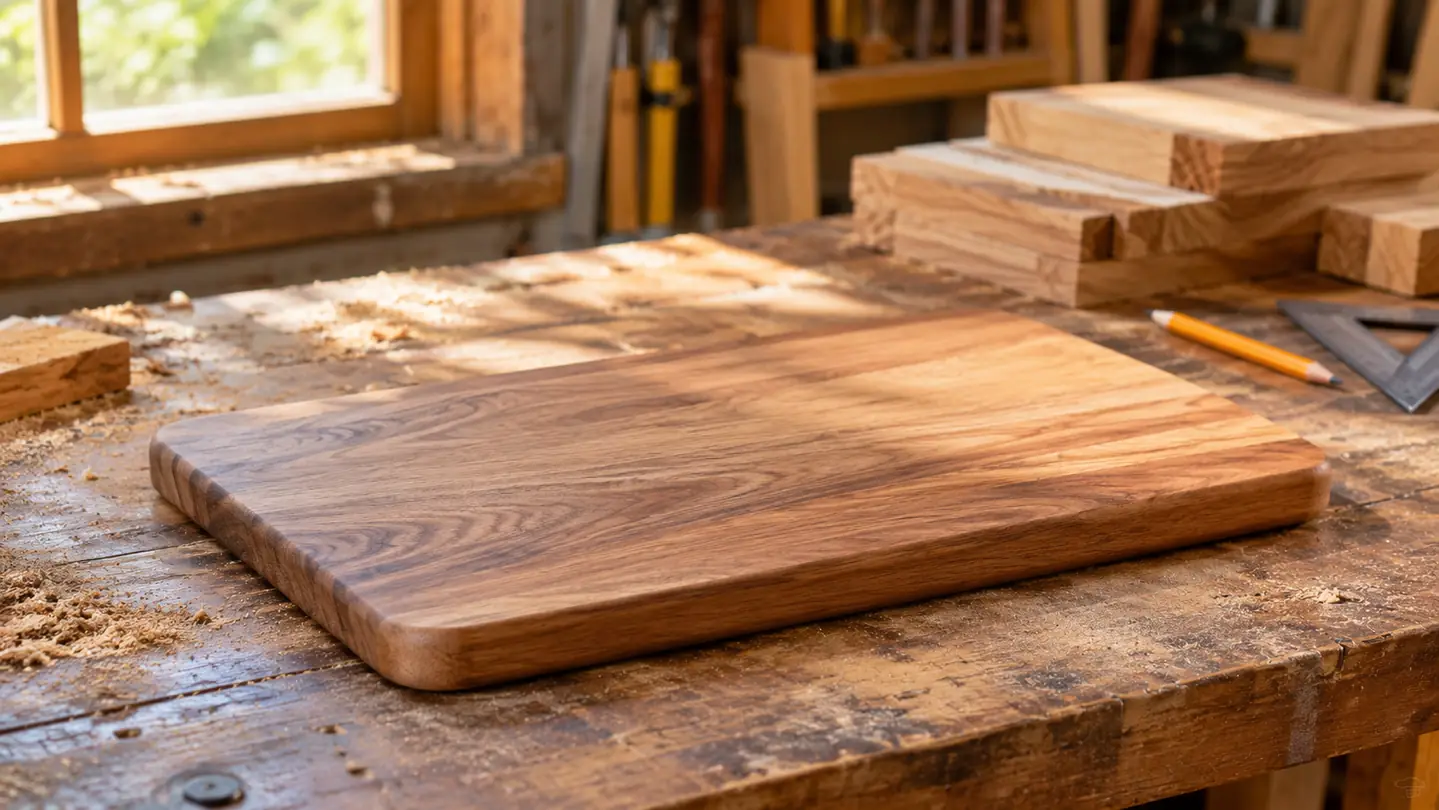
One job sticks in my mind. Last March I was finishing a maple cutting board, 18 inches by 12, and the roundover on the long edges needed to be identical on both faces. I set the depth on a scrap of the same maple, ran one edge, flipped the board, ran the other, and the two profiles matched to the point where I could not feel the seam with a thumb. That is not a thing I could do reliably with a trim router that had a sloppy depth collar. It is the single best argument for the Bosch that I can make, and it has nothing to do with horsepower.
The soft-start circuit is the detail I did not know I wanted until I had it. A small router that comes on at full speed jumps in your hands, and the first time that happens with a chamfer bit an eighth of an inch from a finished face, you learn respect fast. The Colt spools up instead of snapping on. Two lines on a spec sheet. A very different morning at the bench.
The self-releasing collet deserves its own mention, because it is the small thing that keeps the tool pleasant. On cheaper routers you loosen the nut and then pry at the bit, or tap it, or swear at it. Here the collet lets go on its own once the nut is broken loose. After a hundred bit changes that difference is not a feature anymore, it is the reason you stop dreading a bit change in the middle of a project.
The depth adjustment has held up better than I expected for a tool in this class. Macro to get close, micro to get exact, and the micro is fine enough to move the bit a few thousandths at a time without overshooting. I set height on scrap, cut, check the profile against the light, tweak, and cut again. It has not drifted on me mid-cut. I have used cheap trim routers that did, and there is no recovering a board once the bit has walked down into it.
What I Liked
- Soft start, so it does not jump when you pull the trigger
- Micro depth adjustment fine enough to dial in a roundover on scrap and repeat it
- 3.3 pounds, comfortable one handed on vertical edges and overhead work
- Self-releasing collet lets go of the bit without prying or swearing
- Finger support pockets in the base casting genuinely steady an edge cut
Where It Falls Short
- 1/4 inch shank only, so the useful big bits are off the table
- Fixed base only, with no plunge capability
- 1 HP bogs down in white oak and hard maple unless you take light passes
- Tall body on a small base wants to tip on narrow edges if you get careless
- Chips go everywhere, so the shop vac nozzle lives next to the cut
A quarter inch shank in a 1 HP motor is a sensible pairing. A quarter inch shank asked to do the work of a half inch bit is how a board gets ruined.
The Depth Adjustment Is the Part I Underrated
Setting bit height on a fixed base router is the whole game, and the Colt makes it easier than it has any right to be at this size. The macro knob gets you into the neighborhood. The micro knob moves the bit in small, repeatable increments, and the scale on the base is readable without hunting for reading glasses, which at 63 I appreciate more than I would have at 40. I can take a roundover from a whisper to a full quarter inch in steps I can actually control.
The habit that makes it work: unplug the router, set the height, chuck the bit, snug the collet, then check the depth against a scrap of the same stock before the good piece goes anywhere near it. Every time. It takes ninety seconds and it has saved me three boards I can remember. The adjustment is repeatable enough that once I find the setting for a 1/8 inch chamfer on 3/4 stock, I can come back to it later in the same session without re-cutting scrap.
The one habit I would pass on: keep a scrap of every species you use in a milk crate under the bench. Poplar, white oak, maple, cedar. When the depth needs to change, you set it on the scrap, not on the project. It costs nothing, it takes a minute, and it means the good board only ever sees the cut you already proved.
There is more bit capacity here than the size suggests. The fixed base accepts bits up to 1-5/16 inches, which covers a wide range of roundovers, chamfers, flush trim bits and small pattern bits. The real limit is not the opening, it is the motor and the quarter inch shank behind it. A big panel bit will physically fit and you should not run one. What the capacity actually buys you is room to see the cut and keep the base flat while the bit is buried in a shallow groove.
Where It Falls Short
Power is the honest limitation. The motor is rated 1.0 HP max at 5.6 amps, and in white oak a deep roundover will let you know it. My rule is a quarter inch of cut depth per pass in hardwood, less if the bit is wide. Do that and the finish is clean and the motor stays cool. Get impatient and take the full depth in one go, and you get a labored cut, a burnished edge and a bit that is hotter than it should be. That is not a quality problem. That is 1 HP doing what 1 HP does.
The Adirondack chair set is where I got humbled. The arms are white oak, an inch and a quarter thick, and I wanted a 3/8 inch roundover on all four edges. I tried to take it in two passes because I was in a hurry, and the second pass told me exactly what it thought of that. The motor dropped in pitch, the bit chattered, and I ended up with a burnished stripe along the arm that took twenty minutes with a card scraper to remove. Three lighter passes on the next arm gave me a finish that needed no scraping at all. Same bit, same wood, same router. The only variable was patience.
The narrow edge problem is real. On the edge of a cabinet side or a chair leg, the base has less wood under it than the tool wants, and the whole router will tip if you let it. This is where bad cuts happen, and it is where a trim router separates careful users from lucky ones. Clamping a second piece of stock at the same height to widen the bearing surface is the fix, and it takes two minutes. I do it every time now, which tells you how many times I did not.
Plunging is the other gap. There is no plunge base in the box and no way to drop the bit into the middle of a panel. For a stopped groove, you ramp in slowly with the motor running and the base tilted, or you cut it on the table, or you use a different tool. I have done the ramp-in and I do not enjoy it. If your work involves a lot of stopped cuts, this is not the router you want, no matter how pleasant it is on edges and chamfers.
It is also loud. Not uniquely loud, just loud in the way small routers are loud, high and shrill rather than low and rumbling, and it sits right at ear level because you are leaning over it. I wear plugs for anything longer than a couple of cuts. And chips go where chips go. There is no onboard collection, so I keep the shop vac nozzle taped near the cut and sweep the bench between boards, because a chip under the base is a gouge waiting to happen.
Who This Is For
This is the router for the person who builds shelves, cutting boards, small boxes and outdoor furniture in a garage, and who needs to break edges, cut a hinge mortise, flush trim an edge band and cut a shallow dado without dragging out a table. It is the second router most people should own and the first one many people should buy, because it is small enough to keep on a hook and light enough to use on a vertical surface without your arms giving out. The 4.6 star average across a few thousand reviews is roughly what the crowd says too. Mine has earned its hook.
Who Should Skip It
Skip it if you need a plunge base, if your stock runs to hard maple and white oak at full depth, or if your work is raised panels and big cope and stick profiles. Those jobs want a 1/2 inch shank and 2 HP or more, and no amount of care will turn a trim router into that machine. Skip it too if you are buying your only router and you plan to do everything on a table, because a fixed base trim router is a wonderful second tool and a frustrating only tool. I would know. Mine was the only one for the first year, and I spent most of that year wishing for a second.
If your work is edges and small joinery, this is the one
1 HP, 5.6 amps, 3.3 pounds, fixed base, macro and micro depth adjustment, soft start, and a 1/4 inch self-releasing collet. It hangs on a hook and comes off it faster than anything else in the shop.
Amazon Check Today's Price on Amazon →