

I put off buying the Narex 6-piece chisel set for two years, mostly out of snobbery. I had two chisels left over from my father's toolbox and a habit of touching them up on whatever abrasive was nearest, and I told myself that was plenty for the kind of work I do. Then I spent most of a Saturday chopping a set of 3/8 inch mortises for a small walnut box with a blade that had a hollow in the middle of the bevel and a back you could rock on. The joints came out looking like something had dug them. That was the end of my snobbery.
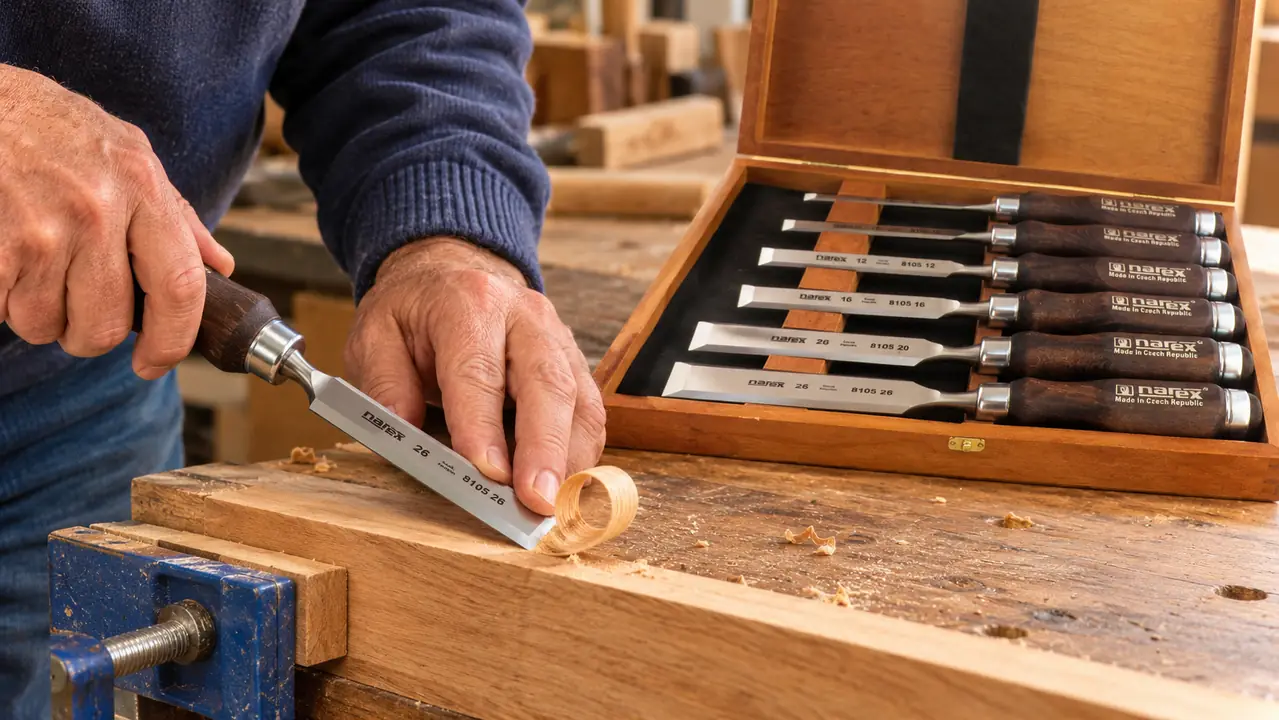
Here is the whole specification, because it is short. Six bench chisels at 6, 10, 12, 16, 20 and 26 mm. Blades of chrome-manganese steel hardened to Rc 59, bevel ground at 25 degrees, with stained European beech handles. The set is listed at 1.6 pounds and the box at about 6.37 inches by 13.5 inches. Narex ships the whole thing in a wooden presentation box. That is everything, and I am giving it to you up front because the rest of this review is about what those numbers turn into once the lid is open on your bench.
This is the version of the review I wanted to read before I spent the money. What the set does well, where it will cost you an evening, and who should walk away and buy something else. I have no interest in telling you it is perfect. It is not. It is, however, the set I reach for every week in a garage shop outside Richmond, and I can tell you exactly why.
The Quick Verdict
Good steel and six honest sizes without paying custom-shop money. You pay for it with one evening of flattening backs and honing six edges before the first cut.
Amazon Check Today's Price →Six sizes that arrive ground but not sharp. One evening fixes that for good.
The Narex 6-piece set is the bench chisel set I settled on after years of fighting dull blades. Check the current listing and confirm the sizes match the work you actually do.
Amazon Check Today's Price on Amazon →How I've Used Them, So You Can Weigh the Rest
My shop is one bay of a two-car garage. Concrete floor, a 20-amp circuit I ran myself, a shop vac on a cart, a pegboard wall, and a workbench I built before I built anything else. Most of what comes out of it is family furniture: bookshelves, a cedar chest, cutting boards, small boxes, a picnic table that has been out in the weather for four years. Chisels show up in all of it. Chopping mortises, paring tenon shoulders, cleaning up a rabbet, chamfering the end of a board so it does not splinter when somebody drags it across the floor.
The 12 mm and the 16 mm get the most work. The 12 mm fits a 1/2 inch mortise with a little clearance, and the 16 mm is what I reach for to pare shoulders and clean the waste out of a dado. The 26 mm gets used less than I expected, mostly for wide paring on the end of a shelf or trimming a plug flush. The 6 mm is the one that surprised me. Small chisels are where a weak set shows itself, because there is not much steel down there to absorb a mistake, and this one has held its edge through more small box work than I can account for.
Take one job from two springs ago, because it is the clearest example I have. I was building a cedar chest for my daughter and the lid needed eight mortises for the hinges and the latch blocks, all at a 16 mm width. I laid them out on a Tuesday evening, chopped four of them before dinner on Wednesday, and finished the last four on Thursday morning before the heat came up in the garage. The chisel tracked straight down the line on every one of the eight. The only thing I had to correct was my own layout on the second mortise, where I had marked off the wrong face and had to plug and re-mark it. When the lid went on, it sat flush on the first try with no planing at the hinges. That is not a thing that happened with the chisels I owned before.
These have been in the shop going on three years. They have cut white oak, hard maple, walnut, cherry, and a fair amount of construction-grade pine a neighbor brought over for shelving. Nothing has chipped badly enough to need a trip to the grinder, and no handle has come off in my hand. That is not a promise about what will happen in your shop. It is a report of what happened in mine.
The Backs Are Not Flat, and That Is Half of What You Need to Know
Every honest review of this set says the same thing, and every one of them is right: the backs are not flat out of the box. Not disastrously out of flat. Flat enough that when you lay the back down on a stone you can see exactly where the low spots sit. On my set the 6 mm and the 26 mm were the worst of the six. The 16 mm was nearly there.
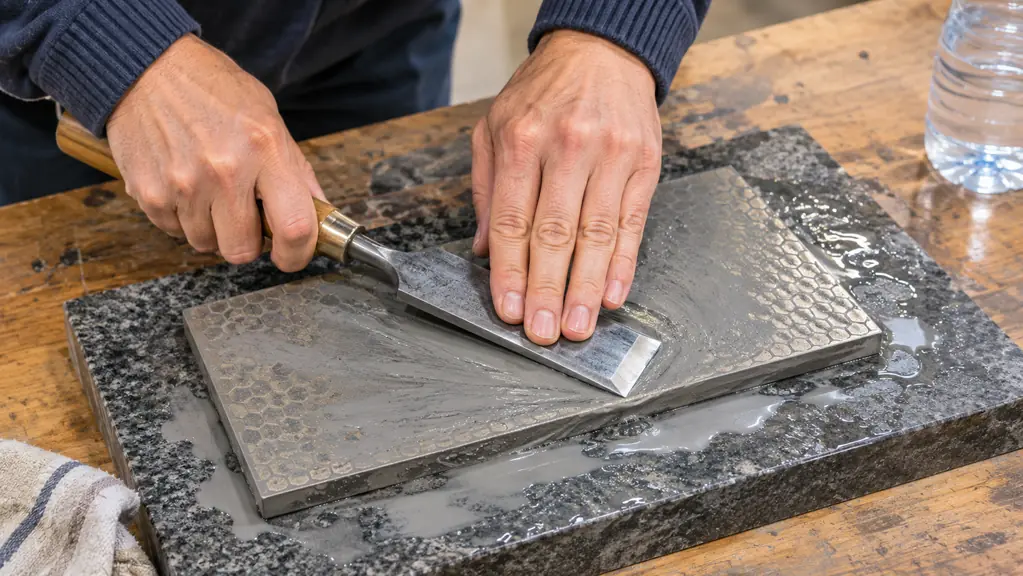
Flattening all six backs took me a little over two hours, spread across two evenings, with a coarse diamond plate and a sheet of abrasive on a granite slab. I did not chase a mirror polish. The point of flattening a back is to get the last inch and a half genuinely flat so the edge has something to meet the stone with, and once that is done you never do it again on that chisel. Two hours, once, for a set you will use for a decade. I will take that trade every time.
The 6 mm is the one I remember. There was a low spot running most of the length of the back near the left corner, and it took the longest of the six, maybe forty minutes of working the plate in small circles with the chisel held flat and checked against the light every dozen strokes. The 26 mm had a similar hollow, but over a wider area, so the plate found it faster and evened it out in about half the strokes the little one took. What you are looking for is a scratch pattern running the full width of the last inch and a half, not a shine. Once I had that on all six, I stopped. My arms were tired and my back was tired and the work was done.
What I will not tell you is that the work is optional. It is not. If you take these out of the box, hone the bevel, and start chopping, the edge has no flat back supporting it. It will dull quickly and it will steer off your line. A good share of the complaints online about these chisels being soft trace back to somebody who never flattened a back. That is not Narex's fault, but it is Narex's problem, because nothing in the box tells you.
The 25 Degree Bevel on Real Hardwood
The blades come ground at 25 degrees, which is a sensible angle for paring and a slightly aggressive one for heavy chopping in hard stock. Rc 59 is on the harder end of what you find in this bracket. Harder steel holds an edge longer and takes a little more patience on the stone. I have not found these difficult to sharpen. I use water stones and I keep the bevel at the 25 degrees the factory ground it at, because I have never had a reason to change it.
Where the steel earns its keep is white oak. I built a run of shelves out of white oak two winters ago, and the mortises in that wood are the closest thing to a real test I have put these through. The edge held for the better part of a mortise before it wanted a touch up. Cheaper chisels I have owned went dull halfway through one. That is the practical difference the steel makes, and it is the reason I stopped thinking of this set as a value purchase and started thinking of it as the set I own.
The shelves were five boards, forty inches long and twelve inches deep, with stopped dados cut by hand because I did not have a router setup I trusted on white oak at the time. Stopped dados mean a great deal of chisel work at the ends, paring back to a line you cannot see from the top of the board, and the 16 mm did nearly all of it. I touched the edge up twice across those five boards, once midway through and once at the end. In pine that same amount of work would have been a single honing. Oak is oak, and I would rather hone twice than fight a blade that wants to fold over.
One caution, and it is the same caution for any bench chisel. Do not pry with them. None of these are built for levering waste out of a mortise, and the 6 mm will not forgive you for trying. I chop with a sharp chisel and I pry with a beater, and the beater is not part of this set. If this is the only set you own, restrain yourself.
The Box, the Handles, and the Small Annoyances
The wooden presentation box is a nice object and a poor shop fixture at the same time. It looks good on a shelf and it protects the edges in transit. It is not a rack. Working a chisel in and out of a fitted slot every time you need one is slower than reaching for a chisel already lying on the bench, and after about a month I put the box up on the top shelf and nailed together a rack out of two strips of scrap oak. If you are buying this as a gift, the box counts for something. If you are buying it to use, plan to build something.
Building that rack took about an hour. Two strips of white oak scrap, each 1-1/4 inches wide and 18 inches long, screwed to the wall above the bench with the strips set about 3/4 inch apart so the blades drop in bevel up and the handles hang clear of the wall. Six slots, spaced by eye. Ugly, effective, and now the chisels sit where I can reach them with one hand while the other hand holds the board still. If you build one, leave more room between the 26 mm and its neighbor than you think you need. The big blade crowds the slot next to it, and I had to move a screw after a week.
The handles are stained European beech and they are comfortable in a way that matters when you have been paring for an hour. There is enough length to choke up on for a fine paring cut and enough bulk to hold on to for a two-handed chop. The ferrules are tight. One handle worked slightly loose in its socket after about a year of steady use, and a tap on the end of it with a mallet seated it again. That is a wooden-handled chisel behaving like a wooden-handled chisel, and it is not a defect.
The 26 mm is a lot of chisel. At 1-1/16 inches wide it is not what you reach for to clean up a small joint, and in a set of six it takes up more than its share of the box. I would rather have seen a 4 mm in that slot, or a second 12 mm. That is my one real complaint about how the set is put together, and it is a mild one, because the big chisel does earn its place on wide paring work.
What Nobody Tells You Before You Buy
The box is not shop storage. The backs need flattening. And the factory bevel is ground, not honed. All six edges need work before the first cut, and if you do not own a stone yet, count that as part of the purchase. People are surprised by that one more than any other.
The sizes skip the small end. If your work is small boxes, inlay, and 1/4 inch joinery, the 6 mm is your smallest chisel and it is bigger than you want for the finest of it. This set is sized for furniture. Read it that way and the choices make sense.
And the honest part. These do not feel like a hand-forged chisel costing several times as much. The steel is good, the grind is even, the handles are well fitted, and the whole thing is a well-made production tool. It is not a tool with a personality. If you are the woodworker who wants to polish a back to a mirror and talk about who made it, this is not your set. If you want six sizes that work, in one box, and you are willing to spend two hours making them yours, it is exactly that set.
What I Liked
- Steel holds an edge in white oak and hard maple where cheaper chisels give up mid-mortise
- All six arrive with an even grind and tight ferrules
- Handles are comfortable for long paring sessions and easy to reseat
- Three years in a working garage shop with no edge chipped badly enough to regrind
- Six sizes cover furniture joinery with no gap in the middle of the range
Where It Falls Short
- Backs are not flat out of the box and need about two hours of work before first use
- Bevels are ground rather than honed, so all six need sharpening before the first cut
- The 26 mm takes a slot a smaller chisel would use better in furniture work
- The presentation box is not practical as shop storage
Two hours on a diamond plate is what turns this set from a value purchase into a tool you will still be using in ten years.
Who This Is For
This set is for the woodworker who has decided to stop fighting their chisels. If you cut mortises and pare shoulders on furniture, if you have a bench and a stone and you are willing to spend one evening flattening backs, this set will do everything you ask of it for a long time. It suits a garage shop, a basement shop, and a bench in the corner of a spare room. It suits people who already sharpen their own tools and people who are about to learn how.
It also suits a first serious set. Six sizes covers the joinery on most furniture projects, and the middle of the range, which is where most of the work happens, is well served.
Who Should Skip It
Skip it if you want to open a box and cut a dovetail the same afternoon with no sharpening. Skip it if your work is small, meaning boxes, inlay, and anything where 1/4 inch counts as a large chisel. Skip it if you already own a set you like at the sizes you use, because this one will not teach you anything your current set cannot. And skip it if flattening six backs by hand sounds like a chore rather than an evening in the shop. That is a real preference and there is no shame in it. Buy a set that arrives ready and pay for the labor somebody else already did.
Six chisels that reward the evening you put into them
If you are ready to flatten six backs and hone six edges once, the Narex 6-piece set will handle everything a furniture project throws at it. Confirm the sizes fit the work on your bench.
Amazon Check Today's Price on Amazon →